Pages

Showing posts with label Sacred Music. Show all posts

Thursday, July 5, 2018

Why I Chose the Ordinariate Community to be My Parish

Zdzislaw Piotr Jasinski, Niedziela Palmowa, 1891.

I recently became a member of the Ordinariate parish in my community, and I am here to put in a good word for the good they are doing for the Catholic Church in their living of the three pillars of Catholic living: lex orandi, lex credendi, lex vivendi; that is, how we pray affects what we believe, both of which in turn have a direct influence how we live. The faltering of one leads to the faltering of the others. Vise versa, the equal upholding of these three pillars results in the thriving of the Church, and such is the case with my Ordinariate Community. 

Edit: For those of you who may be unfamiliar with the term, the Ordinariate are former Episcopalians and Anglicans who have returned to full communion within the Roman Catholic Church, but who have been given permission to retain the liturgical traditions of the Anglican church, such as the celebration of Evensong.

Community -- Living

As a church organist, I have worked for several Protestant churches, and one thing that Protestants do particularly well is this: hospitality and fellowship. The people of the Ordinariate have brought their knack for these things along with them. They are warm, welcoming, honest, and boisterous, with beautiful, loud, adorable children, and they all look out for one another. They opens their hearts and their homes to one and all, for all persons are loved, welcomed, and respected in their midst.

Speaking from my own experience, from Day One they invited me to their coffee hours and to dinner get-togethers. And since my own family lives several hours away, my holidays are usually spent visiting and carousing with these good people! In many ways, they have become my extended family.

Formation -- Believing

One of the greatest problems in the Roman Catholic Church is the lack of catechesis in children and even more so in adults. The Ordinariate community addresses this through formation for both age groups every Sunday after mass throughout the year! For our community, formation topics have varied from Scripture to the writings of Benedict XVI to the lives of holy men and women like Chesterton and Edmund Campion. These formation sessions have been edifying for myself and those around me as young and old participate in insightful and sometimes lively discussions.

Liturgy – Worship

As a church organist, I am a bit of a liturgy geek, and I love the Extraordinary Form of the Roman Rite. The incense, the bells, the chant, the Latin – it all speaks to me in a way that Evensong speaks to many Anglicans and Episcopalians, like an “old familiar cloak passed through the generations. It is … [like] a rambling old house where everyone can find some corner to sit and think, trailing a few absent-minded of faith or doubt in its passing stream,” to quote Stephen Hough. It helps me to obtain a unique level of quiet, peace, and contemplation in prayer, and I will always reserve a special place in my heart for the Extraordinary Form for this reason.

However, the Ordinariate Form brings many of the elements of the Extraordinary form into the post-Vatican II era, as a great deal of the Ordinariate liturgy comprises a literal translation of the Extraordinary form from Latin into the vernacular. This translation is infused with prayers from the Anglican rite. The liturgy is transcendent and beautiful, a far cry from the anthropocentric worship which has overrun so many parishes.

In addition, the liturgical year perfuses the Ordinariate’s daily life from the treats at coffee hour (e.g. blackberries for Michaelmas) to the extra liturgical events like the blessing of candles for Candlemas. The result is a Catholic community infused with friendship, food, customs and traditions and a true sense of belonging (not unlike the wonderful world of Hogwarts School of Witchcraft & Wizardry for those of you who are Harry Potter fans).

If you are fortunate enough to live near an Ordinariate Community, I hope you will visit and get to know them! They are doing good things for the Catholic Church.

Thursday, May 7, 2015

Do One Thing Every Day That Scares You

There is a quote attributed to Eleanor Roosevelt that reads, "Do one thing everyday that scares you."

I don't do it everyday, but one thing I've done a lot this past year that scares me is teaching a children's choir. Getting up in front of people intimidates me, even (and sometimes especially) when they are kids. This past year I took a two semester course in vocal methods for organists and choral conductors, which taught me a lot about the workings of the adult voice and helped me to build my confidence in instructing choirs and leading choral warmups (which I've also learned this past year is the MOST important part of any choir rehearsal, professional or non).

Then this past spring I took a course in the basics of running a children's choir, which included learning about the child's voice, how to structure and lead choral warmups for children, and learning how to teach music education using the Kodaly method. The class also included workshops with conductors such as Melanie Malinka from the Choir School of the Madeleine Cathedral in Salt Lake City, and student teaching with the Notre Dame Children's Choir. Both were invaluable experiences! I also received some hands-on experience starting a children's choir at my own parish where I serve as the music director.

Two things I have learned about working with kids: #1) Don't baby them, don't talk down to them. Talk to kids the way you talk to adults. Even though they are far more honest than adults, they are usually far more forgiving. #2) Kids are musically capable of a lot more than adults think they are, and they will give it to you if you ask it of them. Yes, it will take time (months, even years), but they can sing Palestrina, Rheinberger, Gregorian chant -- real sacred music, if you ask it of them and you teach them well! They haven't had the complacency of mediocrity or self-doubt instilled in them yet.

My last final of the spring semester was for my children's choir course, and the final consisted in teaching a group of 7-8 year olds the difference between quarter notes and eighth notes). It was still intimidating and occasionally painful, and I'm still learning how to teach, how to be more confident as well as more demanding. But I have found that I love teaching music to children, and I am getting better with practice (funny how that works!). I hope to keep challenging myself and to keep improving as I get one step closer to my future parish chorister program! One step closer to teaching sacred music to the future of the church!

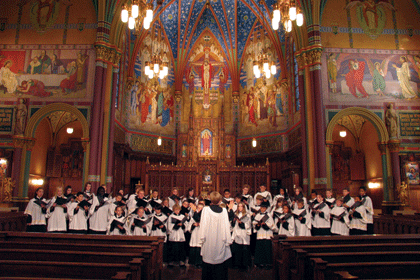
Choir School of the Madeleine Cathedral, Salt Lake City

Wednesday, December 17, 2014

Modern Sacred Music in the 20th Century, Part II: Messiaen & Britten

To read Part I, click here.


Olivier Messiaen (1908-1992)
Olivier Messiaen (1908-1992) may aptly be described as one of the most idiosyncratic composers of the twentieth century. Rather than adhering to a particular school or style, he preferred to create his own unique musical voice through the combination of influences including birdsong, eastern rhythms, his own modes of limited transposition, and his religious beliefs. Although he did not come from a religious family, Messiaen was a devoted Roman Catholic whose faith and interest in mysticism deeply impacted his compositional output. Like Duruflé, he also served as a church musician for almost his entire career and believed that Gregorian chant was the true native music of the Roman Catholic liturgy. Perhaps this explains why his motet O Sacrum Convivium serves as his only work (outside of specific solo organ compositions) designated for liturgical use. Composed in 1937 for SATB a cappella choir, his motet appears relatively early in his ouvre, which perhaps partially explains its reserved musical language. The text, in keeping with Messiaen’s preference for mystical subjects, consists of a meditation on the mystery of the Eucharist written by St. Thomas Aquinas. The motet’s restrained dissonances and muted colors resemble those of late 19th and early 20th century composers such as Fauré and Poulenc, though they sound remarkably conservative when compared to the majority of Messiaen’s work. The rhythmic values, combined into groups of two or three eighth notes, bear the marks of the Solesmes monks interpretation of Gregorian chant (a trait also found in the chant-based works of Duruflé). The texture is primarily homophonic, drawing attention to the lilting, almost ethereal melody in the soprano line. Rather than reciting the text verbatim, Messiaen rearranges the text to create a dramatic arch within the piece. The choir sings through the first three phrases of the text at a pianissimo, crescendoing slightly at “the mind is filled with grace,” then diminishing as it reverently repeats the words “O sacrum.”  There is a slight pause, then he reiterates the opening material, steadily building to a majestic forte as the melody soars up to an A on “futurae gloriae.” As the chorus sings “Alleluia,” the soprano line languidly descends, the texture softening into a pianissimo. The motet concludes with a sonorous major chord in the lower parts, the melody rocking gently to and fro on a subtle dissonance as gentle as a lullaby.


___

Benjamin Britten (1913-1976)
Benjamin Britten (1913-1976) in some ways appears as a bit of an anomaly among the composers included in this discussion. Messiaen and Duruflé were fervent Catholics. Pärt is a member of the Russian Orthodox faith. By contrast, Britten preferred to distance himself from organized religion for the majority of his life. Nevertheless, he wrote a number of choral works for use in worship, Protestant as well as Catholic. These works have earned a permanent place in the choral repertoire due to Britten's ability to combine inventive and modern styles with accessibility to both the tastes of average congregations and the abilities of amateur -- albeit trained -- church choirs. Although perhaps it was not as influential as in the cases of the aforementioned composers, Britten was certainly well acquainted with plainsong and made considerable use of it as seen in works such as the Ceremony of Carols, the Hymn to Saint Peter, the church parable Curlew River, and the cantata Saint Nicolas. 

Britten composed his Hymn to the Virgin when he was sixteen while laid up in the school sanatorium, taking the text from his copy of The Oxford Book of English Verse, 1200-1900, a book he had won as a prize. The text dates from the 14th century and serves as a devotional rather than liturgical prayer, combining Latin and Middle English texts to create a prayer in which the church militant meditate upon the Blessed Mother and ask her intercession. Composed for double choir, the four-part homophonic texture lends the work a beautiful clarity akin to that of hymnody, while the melismas on the Latin words imitate harmonized plainsong. The harmonic language appears to draw from the early English music revival, a revival which originated in the late 19th century and characterized by a renewed interest in the music of William Byrd and other English polyphonic composers. It also included the tradition of English folk song. Composers not only studied this music but also sought to imitate it in new compositions. Britten would later reject this trend, but the modal harmonies of the Hymn do just the opposite, complimenting the medieval text. Though the harmony and texture are simple, Britten imbues the piece with drama by having the two choruses present the text antiphonally: one choir sings in English while the other comments on or completes the thought in Latin. The choirs sing separately in the first two verses, the drama building in the second verse. Then both forces join together in verse three, the soprano of Choir I and all of Choir II singing the melody while the lower voices of Choir I ascend in largely stepwise motion, climaxing on the phrase,“Lady, queen of paradise.” The hymn concludes in mystical tranquility, ending with the familiar lilting melisma from the previous verses.


Conclusion

 Throughout the 20th century, the Catholic Church encouraged the composition of modern forms of sacred music. On November 22, 2003, the anniversary of the promulgation of St. Pius X’s motu proprio Tra Le Sollecitudini, St. John Paul II wrote, “This does not mean copying Gregorian chant, but rather seeing to it that new compositions be pervaded by the same spirit that gave rise to and so molded that chant. Only an artist profoundly immersed in the sensus Ecclesiae may try to perceive and translate into melody the truth of the Mystery that is celebrated in the Liturgy.”

How could the traditional language of sacred music be reconciled with the new musical languages of Debussy and Ravel, the serialist techniques of Schoenberg, and other modern trends? The 20th century produced a significant number of composers of religious and sacred music capable of meeting this challenge. These four composers were able to integrate elements of the past with elements of the present to create a musical language of their own. French composers Duruflé and Messiaen combined the colorful harmonies of the French school with various elements of Gregorian chant, ranging from direct quotation and variation to rhythmic inspiration hearkening to the Solesmes interpretation. Duruflé also incorporated 19th century elements as seen in the romantic melodies in the middle section of the Gloria and in the Benedictus. Arvo Pärt engineered his tintinnabuli style from the foundations of tonality (such as the triad), elements of plainsong and Renaissance polyphony, and certain aspects of 20th century serialism. In his Hymn to the Virgin, Britten likewise incorporates traditional elements of English modality and hymnody into a new mystical and dynamic language. All of these composers manage to use elements of the old to create something new in keeping with the spirit of the liturgy without sounding antiquarian.

The music of Messiaen, Britten, Duruflé, and Pärt prove that it is possible to compose new sacred music in keeping with the spirit of the liturgy. The integration of the old traditions of sacred music with the dynamic creativity of these four composers did not result in the archaic survival of a dead culture but rather served as the instigator for new innovations in sacred music. Their compositions breath the spirit of ancient religious chant, but the overall idiom is decidedly modern. They prove that the model of plainsong, far from limiting the composer, instructs him in the qualities of true art in keeping with the sacramental nature of liturgical music. It is in this way that cultural innovation gives birth to new forms of expression, new forms which serve as worthy successors of the timeless masterpieces of the past.

Saturday, April 19, 2014

Modern Sacred Music in the 20th Century (or What It Should Have Sounded Like), Part I: Duruflé & Pärt

The Catholic Church was once responsible for some of the most beautiful art and music ever made. If one needs proof of this, one only has to recall the splendid ceiling of the Sistine Chapel, the glory and terror of Mozart’s Requiem, and the brilliance of the Sainte-Chapelle in Paris.


Rouen Cathedral in France
The Last Judgement, Michelangelo. Detail.


Although the Catholic Church was once a patron of the arts, she would certainly have a difficult time supporting such a claim today. In fact, the typical art and music one finds in most Catholic churches is not only “not beautiful” but is actually some of the most ugly, banal, and uninspiring art that mankind is producing.


But is this what the Church intended for the art of the 20th century? What was modern sacred music supposed to sound like?

First, a little about the role of music in Catholic liturgy, otherwise known as sacred music. According to Church teaching, sacred music is meant to give glory to God and to inspire its listeners to live the teachings of the faith. Because the Catholic liturgy is supposed to be the divine meeting of heaven and earth through the person of Christ, the music which is used within its context must not sound like the normal music one might hear in  everyday life, such as on the radio or even in the concert hall. For this reason, a jazz mass or a polka mass would be extremely problematic at best. This principle can also be demonstrated in the origins of stained glass windows.  The light of the outside world was “sanctified” through the colors of the stained glass, purifying it so it might enter into the sacred space.

From the very beginning of the 20th c., the Church expressed great concern for the state of music in Catholic worship. In 1903, Pope Pius X composed a personal letter to the Catholic Church titled Tra le Sollecitudini in which he called for the restoration of sacred music, the teaching and singing of chant and sacred polyphony in parishes, and the composition of modern music possessing an ecclesiastical and sacred character.


Specifically, “Gregorian chant has always been regarded as the supreme model for sacred music, so that it is fully legitimate to lay down the following rule: the more closely a composition for church approaches in its movement, inspiration and savor the Gregorian form, the more sacred and liturgical it becomes; and the more out of harmony it is with that supreme model, the less worthy it is of the temple.”

Thanks to Pius X and the chant restoration undertaken by the Benedictine monks of Solesmes Abbey, Gregorian chant underwent a renaissance in France between 1903 and 1963. It was used in sacred and secular compositions by numerous composers and taught in choir schools such as Rouen Cathedral, where children were trained in the singing of chant and polyphony ranging from the works of Palestrina and Victoria to Haydn and Fauré. 

Maurice Duruflé, 1902-1986.
Among these students was future composer and organist, Maurice Duruflé (1902-1986). As a boy chorister, Duruflé was immersed in a world of solemn Catholic liturgy and aesthetic spirituality which formed the foundation for his artistic endeavors for his entire career. As he went on to complete his musical studies at the Paris Conservatory, he synthesized his childhood schooling in the ancient melodies of plainsong with the harmonies of contemporary composers such as Debussy and Ravel to create a modern style of sacred music.

In 1963, the Second Vatican Council promulgated the Constitution on the Sacred Liturgy, reiterating the primacy of chant and sacred polyphony in the liturgy and encouraging new forms of sacred music organically derived from these traditional models. Composed in 1966, it is speculated that Duruflé may have written the Messe “Cum jubilo,” Op. 11 to demonstrate the potential within the Council’s instruction and prove the compatibility and relevance of plainsong with (at least initially) modern harmony. 

Dedicated to his wife Marie-Madelaine Chevalier Duruflé, the title “Cum jubilo” comes from the chant mass on which the work is based. Also known as Mass IX, it is designated for feasts of the Blessed Virgin. The overarching tone of the original mass is one of joyful serenity, a tone which the composer both adopts and subverts over the course of the work. As one might expect, Duruflé borrows heavily from the chant melodies on which the Messe is based. While not all of the melodies are derived from the source material, the melodies which are original to the work are certainly chant-inspired. The Kyrie serves as a prime example, opening with the original chant melody in the first violins and clothed in luscious harmonies, harmonies which have lead many to label Duruflé as an impressionist. The men’s chorus enter the texture with a newly-composed melody so imitative of chant that it is hard to distinguish between the original chant and that of Duruflé. This method continues for the duration of the Messe, the composer quoting or varying the original chant melodies while sewing in his own material, weaving a tapestry of the old and the new.


Pius X stipulated in his motu proprio that new sacred music had to be “good art, holy, and possess the quality of universality,” qualities that are all found in various forms of plainsong across cultural boundaries.  As seen in the Messe, Duruflé was able to blend the modern harmonies of Debussy and Ravel with the ancient melodies of plainsong to create a modern style of sacred music, proving the compatibility of chant and (at least initially) modern harmony while shunning the “profane theatricality of the past.” He combined the sacred and secular in a manner appropriate for the liturgy, respectful of the tradition but also progressive.

Pius X’s letter gave Duruflé the motivation to persist in his musical style well into the 1960s, after which his works were thought old-fashioned, cast aside by a new call for “musical relevance” in the church.

The Second Vatican Council’s Constitution on the Sacred Liturgy was meant as the successor to Pius X’s letter. However, though the document was sound in principle, its application proved disastrous for sacred music.  Though it insisted on the primacy of chant and polyphony in the liturgy, its permission of vernacular languages and music effectively spelled the end of Latin-texted chant, and thus, the abandonment of chant in the liturgy in favor of more popular tunes and styles.
__


Arvo Pärt, b. 1935.
While sacred music in Catholic liturgy began to unravel in the 1960’s, Arvo Pärt (b. 1935) was emerging on the modern music scene in Estonia, a republic of the Soviet Union. After suffering persecution from the government for the use of serialism and religious texts in his early compositions, Pärt fell silent for several years and turned to the study of Gregorian chant and Renaissance polyphony. Out of this silence emerged a new style of music which Pärt called Tintinnabuli, a style that is meant to replicate the pealing of bells, their “complex but rich sonorous mass of overtones ... the idea of a sound that is simultaneously static and in flux.”


Pärt described his musical journey in his own words, “The numbers of serial music were dead for me ... With Gregorian chant that was not the case. Its lines had a soul.” He added, “Gregorian chant has taught me what a cosmic secret is hidden in the art of combining two, three notes. That’s something twelve-tone composers have not known at all.”

Pärt's Berliner Messe for chorus or soloists and string orchestra was commissioned for the 90th German Catholic Day in Berlin, 1990. In the traditional Catholic liturgy, the Credo functions as the proclamation of the core beliefs of the Christian faith. Pärt’s setting of this text serves as a prime example of his tintinnabuli style. Though decidedly more reserved in tone and orchestration when compared to the romanticism of the Gloria from Duruflé's Messe "Cum jubilo", it is equally jubilant in character. Imitating the composers of the early Renaissance, Pärt’s writing emphasizes the horizontal, focusing on melodic lines rather than vertical harmonies. The essence of tintinnabuli is the pitting of a scalar chant line, which revolves stepwise around a central pitch, against a second line, which outlines an arpeggiated single triad and thus creating a harmonic or tonal center. The second line is called the tintinnabuli voice due to the bell-like tones which are created when it collides with its counterpart, though both lines tend to follow the same general contour. The emphasis of the single triad ultimately eliminates the possibility of harmonic progression. However, the music is still in motion! Instead of deriving the forward motion from the harmony, the music is propelled by the tension and release created by the collision and resolution of the two core lines, by the use of imitative counterpoint borrowing aspects of 20th century serialism, and by the rhythmic drive of the sung text, which is set according to its natural syllabic rhythm in the style of plainchant. The harmonic stasis draws attention to the chant line, refocusing the listener’s attention to the fundamentals of melody, harmony, and language-- the “cosmic secret” in combining two, three notes.


Unlike Duruflé, Pärt has yet to write music specifically intended for the Catholic liturgy. But Pärt's music can certainly be viewed as sacred music. Due to their total immersion in the world of chant and polyphony, the music of Duruflé and Pärt “breathes the spirit of ancient religious chant and yet the overall idiom, particularly the harmonic language, is thoroughly modern,” proving that it is possible to compose modern sacred music that is both in keeping with the spirit of the Catholic liturgy and also awakening -- in short, worthy successors of the universal masterpieces of the past.

Tuesday, October 16, 2012

Why Singing Sacred Music is Like A Magical Wardrobe

The transition from studying sacred music at a solid Catholic university to studying music at a secular conservatory has certainly been an interesting one. One of the keenest differences is obviously the change from a predominantly Christian atmosphere to one where there is seldom any outward expression of religious belief of any kind. Although my fellow organ students and I are certainly exposed to many religious compositions through our internships at various Christian denominations -- presbyterian, episcopalian, catholic, etc. -- I would say the vibes of the studio overall are also largely secular.

By now you're probably thinking, "Well, of course, it's going to be secular! It's a school full of liberal musicians!" 

Haha, yes, I was aware of that even before Day #1. So why am I bringing this up? 

St. Mark's Basilica, Venice, Italy
I was recently placed in an interesting scenario that struck me as particularly disjunct from my previous musical experiences in undergrad. This semester I have been working with an ensemble of early music singers who are performing a great deal of music by Italian composer Giovanni Gabrieli. Gabrieli was the principal organist at Saint Mark's Basilica in Venice and wrote a great deal of sacred choral works as well as secular instrumental works. Many of the pieces which this ensemble is singing are sacred works, such as his setting of "Miserere Mei Deus," which is also known as Psalm 51.

What is Psalm 51? It is a prayer, a cry to God which King David wrote when he was at one of the lowest moments of his life. He committed adultery with Bethsheba, he murdered her husband, and he had lost a son because of his sins. In this particular psalm he is asking God to forgive him.

"Have mercy on me, O God, according to your great mercy. ... For I know my iniquity, and my sin is always before me. Against you, you alone, have I sinned, and have done evil in your sight ... You shall sprinkle me with hyssop, and I shall be cleansed: you shall wash me, and I shall be made whiter than snow. ... Create in me a clean heart, O God: and renew a right spirit within me. Cast me not away from your face; and take not your Holy Spirit from me." 

Sitting in on the rehearsals behind my little continuo organ watching these students and fellow musicians sing this piece, it struck me as odd that for a significant number of these singers, it was quite possible that the words made little difference to them. Yes, they cared about the inflection and the strong-weak syllables, the pronunciation, the musical notation, etc. in short *how* the text was set.  But I wonder how much consideration they put into the meaning of the words: that what they are singing is also a timeless prayer, a cry of love, remorse. It's not just music, singing, it can be an expression of something so much deeper! 

Lucy and Mr. Tumnus from
The Lion, The Witch, and the Wardrobe
By C.S. Lewis
This scenario seemed ironic to me.  When one is singing sacred music, there is certainly a level of beauty that is readily apparent, in this case the music which Gabrieli composed to adorn the text. This music, this type of beauty, could be said to be a universal language -- most human beings, even atheists, will admit that they are moved by such beautiful music. It speaks to them in a way that is more easily understood.

But there is another type of beauty that was already there, that of an honest plea to God, which the Holy Spirit inspired King David to utter in his hour of darkness. It is a sacred text, timeless, inspired by God. And even though the musical setting is indeed wonderful, the words are what inspired the composer. The text and its Author are what make the music sacred in the first place. They transcend the musical adornment. This kind of beauty is not readily apparent to the casual listener/singer.  There is a level of religious devotion -- shall I call it love? -- a disposition of the heart which the singer needs in order to appreciate this level of beauty. 

It so happens that while I was mulling this all over in my head, I was in the middle of a Chronicles of Narnia kick (I go through these from time to time, now I'm on Harry Potter)-- listening to the music, reading quotes, posting C.S. Lewis and the like all over my tumblr, etc. And somehow, these two came together in what I though was a fascinating analogy. 

Lucy Pevensie, played by Georgie Henley in
Disney's The Lion, The Witch, and the Wardrobe

Do you remember the scene in The Lion, The Witch, and the Wardrobe in which Lucy Pevensie encounters the wardrobe and she first walks through to the land of Narnia, full of magical landscapes, fauns, and tea parties?  Later in the story, she tries to show this world to her older siblings, but all they see is the back of a wardrobe.  I would pose that singing sacred music is like encountering this magical wardrobe. Some musicians sing Psalm 51, Mass texts, chant, Palestrina, etc. and find themselves in Narnia -- not literally, of course, but because their hearts and minds are disposed through love to prayer, they experience the musical settings of these sacred texts on a far more intimate level. Other musicians sing these pieces and, while they admire the manner in which the piece has been composed, all they see is the wooden back of a wardrobe.

So is it better to be a Christian and sing sacred choral music? I would venture that, while it may not always be the case, it most definitely can be!

Saturday, May 12, 2012

The Sacred Music Program at Franciscan University of Steubenville

As a graduate of the class of 2012 from Franciscan University of Steubenville with a Bachelor of Arts in Sacred Music with a concentration in organ, I was recently asked to share a few words on the quality of the University's Sacred Music Program and how it has prepared me for the future. It was difficult to sum up my experiences within the Sacred Music Program in only a few words as these past four years within the program have been filled with invaluable, life-changing opportunities for me as a musician. Where do I even begin? And I am sure I will still receive numerous benefits and insights from my time here many years after my graduation. That being said, I have included my quote below in order that you might get an idea of the beautiful experiences and the excellent education which the Sacred Music Program has to offer.


"My formation within the Sacred Music Program has been a time of immense blessing, inspiration, and thorough immersion into the musical traditions of the Catholic Church. 
It is a gift to be taught by faculty that are loyal to the teachings of the Catholic Church and possess a love and a zeal for the faith. This attribute is uncommon in the field of music. It is a substantial blessing to be taught by Catholic musicians who become just as enthused as their students over a stirring liturgical text as they elucidate the theological meaning behind the melodic setting of a word or phrase. I would not be the accomplished musician I am today if it were not for their artistry, dedication, and perseverance. I did not begin to study organ until I changed my major to sacred music at the end of my freshman year, yet under Dr. Paul Weber’s careful guidance my skills as an organist have grown in leaps and bounds.
The program’s careful attention to the individual needs of the student, their encouragement of the pursuit of excellence, and their emphasis on beautiful music as an integral part of evangelization have nurtured a group of musicians who are armed with a double edged sword: the sword of truth and beauty. Truth speaks to the mind, but beauty speaks to the heart. Pope Benedict XVI calls sacred music 'an audible and perceptible rendering of the truth of our faith. In listening to sacred music - suddenly we feel: it is true!'
This program is forming musicians for the conversion of souls."

Below are a few videos from the Schola Cantorum Franciscana's concert at St. Elizabeth Seton parish in Carnegie, Pennsylvania this past semester of spring 2012. We were graciously invited to the parish to give a performance in the recently expanded space. The concert was a beautiful experience for both the members of the schola and the parishoners. One older woman approached me at the end of the concert and told me that her husband had passed away a few months ago. "Your music is helping me to heal," she said. "It was a gift." I counted her words as one the highest compliment one can ever receive as a musician. A true musician does not perform his art for himself but for others, to relieve pain and to heal souls. If one has accomplished this for even just one person, than he has succeeded in his art. May the glory of God be always at the center of this program.


 Excerpts from Palestrina's Missa Tu Es Petrus, 
sung by the Schola Cantorum Franciscana of Franciscan University.


Sunday, December 18, 2011

What Christians can Learn from an Atheist


Christopher Hitchens: God's Favorite Atheist?
Christopher Hitchens. Born 13 April 1949. Died 15 December 2011.  I was not familiar with this man until today, only a few days after his passing, however after reading a few articles on the man reflecting on his life and his zealous atheism, I am uncertain as to whether or not I would like him or if we would have been friends. He certainly seemed as if he was quite a likeable character even in Catholic and Christian circles. I think I would have at least held a considerable amount of respect for him.  I would also like to think I understand at least some of the reasons behind his disbelief. None of these reasons may have been decisive factors, but they certainly seemed as if they were contributors to his self-dubbed "anti-theism."  I would like to discuss two significant points that Hitchens made in a recent interview and their significance in evangelization. Hitchens was wrong about many things, but he was right on these two points. In an article titled Hitchens: God's Favorite Atheist? posted on the World Net Daily, author Art Moore describes an interview he had with Hitchens.

Noting that Christian evangelists say they are motivated by a desire to please God, I asked Hitchens – pointing to his "zeal" for his message – what motivates him.
"Well, intellectual scorn, really. Frankly," he said. "A sense of superiority, arrogance."
He quickly made it clear that he was speaking for himself.
"It's a feeling of just intense irritation that people are allowed to say that they are people of faith. They feel that by making this statement they have added to the argument," he said. "By announcing they believe something for no reason at all, without any evidence, they don't contribute to the discussion."
(Read the full article here:Christopher Hitchens: God's favorite atheist?http://www.wnd.com/?pageId=378513#ixzz1gumXwrUi.)


Christina's World, Andrew Wyeth.
This part of the interview reminded me of a point that my ethics professor, Professor Javier Carreno, made on the first day of class last spring during my studies abroad in Austria as part of the Franciscan University Austria Program. He told us about a fashion competition that took place a few years ago during which one of the judges, a homosexual, inquired as to the reason behind the traditional views on marriage held by one of the contestants who was a Christian. The contestant responded that she believed that marriage was between a man and a woman because that was what she was raised to believe. She had been taught that her whole life. The judge replied that her reasoning was stupid. When he finishing the story, I thought my ethics professor was going to uphold the bravery of the contestant for standing up for what she believed. However, my professor said that in a way the judge was right. The reason that the girl had given for her belief was stupid. It's not enough to say that you believe something because you have been taught it your whole life. This is poor reasoning, if it could be called reasoning at all. One needs to actively wrestle with their beliefs and either reject them or take them on as their own.  Christians, especially Catholics, need to take responsibility for their faith through ongoing conversion, forming themselves in their faith through philosophy and theology. Hitchens called attention to this fault in certain Christians who simply say they have faith, and think that this simple statement is good enough. Hitchens had every right to voice his irritation with such people. Catholics need to be capable of answering not only for what we believe but why we believe it.

But he said one of his "big quarrels with the Anglican church, the one in which I was baptized, is that it got rid of the King James Bible for the most part and the old hymnbook."
"They now sing and read these banal versions of [liturgy], which I used to enjoy," he said.
"I now go to an Anglican or Episcopalian ceremony, and I'm just horrified by what they've lost," he said, "what they threw away when it was unarguably a huge, aesthetic advantage."


Hitchens called attention to the need for beauty as well as truth in Catholicism. The significance of beauty in the conversion of the human person is often neglected when it comes to evangelization . . . at the expense of souls like Hitchens'. Beautiful art, beautiful music, beautiful language are what Hitchens calls "a huge aesthetic advantage." Russian author Fyodor Dostoyevsky said once, "Beauty will save the world." Pope Benedict XVI has called beauty the language of the human heart.  He says, "The encounter with the beautiful can become the wound of an arrow that strikes the heart and in this way opens our eyes so that we can see the truth more clearly." Note that Hitchens specifically mentions the language of the Anglican liturgy and the music. How we pray and what music we sing at the liturgy does in fact matter. Dr. Peter Kreeft gave voice to this in a lecture he recently gave at Franciscan University titled, "How to Win the Culture War," where he mentioned an instance in which he had accompanied a Muslim friend to Mass one day.  The Muslim said afterwards that while the beauty of the architecture had lifted his soul upwards, the language of the liturgy had left his soul horizontal and flat. In the same talk, Kreeft spoke of two separate atheists he knew who converted to Catholicism after hearing the music of Johann Sebastian Bach. For some people, it takes more than just the naked truth to draw them into the fold. It takes the harmonies of Faure's Requiem, the stirring use of shadow and light in a Caravaggio painting, the lofty spires of a cathedral. Benedict XVI calls sacred music "an audible and perceptible rendering of the truth of our faith. In listening to sacred music - suddenly we feel: it is true!" This is a principle that applies to all forms of art.  
Although the Catholic Church has always advocated the use of beautiful art as an integral part of evangelization, her support has not always been properly  represented in the liturgy or recognized by bishops, priests, and laity. Fortunately, this is beginning to change. With the arrival of the new translation, the language of the Roman Rite has improved immensely.  Through the work of our beloved Holy Father Pope Benedict XVI, organizations such as the Church Music Association of America and the sacred music programs of Franciscan University and Ave Maria University, sacred music is beginning to make a come back in the Church. These institutions and programs are helping artists and musicians to recognize the need to use their gifts for the conversion of souls. They are shown that it is not enough simply to create art. Rather, they must be taught the principles of beauty behind it so that they can create art and music containing the qualities of universality, goodness of form, and sanctity. I conclude with a passage from Bl. John Paul II's Letter to Artists: 


Statue of St. Paul at St. Paul's Outside the Walls Basilica, Rome.

 "Mine is an invitation to rediscover the depth of the spiritual and religious dimension which has been typical of art in its noblest forms in every age. It is with this in mind that I appeal to you, artists of the written and spoken word, of the theatre and music, of the plastic arts and the most recent technologies in the field of communication. I appeal especially to you, Christian artists: I wish to remind each of you that, beyond functional considerations, the close alliance that has always existed between the Gospel and art means that you are invited to use your creative intuition to enter into the heart of the mystery of the Incarnate God and at the same time into the mystery of man."


Hitchens may be counted among the victims of the rational and aesthetic impoverishments occurring within Christianity today, but I am praying and hoping that such times are coming to an end. 

Sunday, May 8, 2011

Educating The Heart

This past semester on main campus at Franciscan University, the conductor of the Pittsburgh Symphony Orchestra, Manfred Honeck, came to give a lecture to the students on the connection between music and faith. I was unable to attend the lecture due to the fact I was thousands of miles away on another continent, but I heard the lecture was a tremendous success, and after reading an article on the lecture from the Franciscan Way magazine, I thought I would post it on my blog. I find him a wonderful example of how a serious Catholic musician/artist ought to live their life, a rare find these days. Enjoy!

Over the past three decades, Manfred Honeck has made two names for himself. The first is as one of the greatest symphonic conductors of our age.
An accomplished violinist and violist, Honeck has both conducted and played with Europe's finest orchestras, including the Vienna Philharmonic, the Czech Philharmonic, the Norwegian National Opera, and more. And since assuming the post of music director for the Pittsburgh Symphony Orchestra in 2008, Honeck has strengthened the city's symphony, securing its reputation, both in Europe and America, as one of the world's finest.
That, however, is only the first name Honeck has made for himself. The second is as a Catholic devoted to his faith and family.
In the world of the performing arts, the religiously devout are the rarest of breeds. But Honeck, who is the father of six, with one son in the seminary, is unabashed about his faith. He prays before concerts, attends daily Mass as often as his continent-hopping schedule permits, and even has a chapel in his Austrian home. To him, his music and his faith are all of one piece, each illuminating the other.
Manfred Honeck
Conductor of the Pittsburgh Symphony Orchestra
Which, as he made clear when he delivered the second annual John Paul the Great Fine Arts Lecture at Franciscan University, is exactly how God designed it to be.
"People today long for spirituality," Honeck told students at the February 9 lecture. "We have machines. We have the Internet. But that doesn't touch our souls, and it can even leave us feeling like it is a cold, cold world. We need something that goes deeply into the soul, that touches our emotions, and reminds us who we are."
One of the "somethings" that can do that, he continued, is music.
"It has the potential to go deeper even than film or words," he explained later in an interview with Franciscan Way. "If you let it in, it can actually help you understand your soul. And if it's sacred music, that's even more true. It's like a telephone number to God."
As a conductor, Honeck strives to be something of an operator, using that "telephone number" to connect his audience to God and truth. In his lecture, he walked students through how that's possible, illustrating his points with musical selection from his 2009 performance of Mozart's Requiem in Pittsburgh's Heinz Hal. And, as the talk progressed, it became clear that doing what Honeck does requires more than just technical skill.
First, as Honeck himself will tell you, it requires understanding, a careful and thoughtful attentiveness to a composer's objectives. As Honeck described it, to convey the meaning behind a piece such as Mozart's Requiem one has to read the music like one reads a letter, striving to understand what the composer was trying to convey. The conductor in turn has to explain that message to the orchestra.
"If we both understand the clear meaning of every note, every word, then the audience will get the meaning, too," he said.
What Honeck doesn't say is that approaching music the way he does also requires great courage. It takes courage to openly confess that you want to "bring God and spirituality" to people. And it requires courage to strive to do it as Honeck does - explaining Catholic doctrines of heaven, purgatory, and hell to musicians so the might understand the meaning behind what they're playing; introducing new musical elements such as Gregorian Chant and church bells into well-known pieces, so that echoes of the liturgical make their way into the concert hall; and incorporating readings from the Bible or meditations on death into the performance so that people's hearts might become a bit more receptive to the message behind the music.
It takes courage to do all that not only because it's musically risky, a variation from the norm, but also because it's professionally risky. It's the sort of thing that even when done well can raise suspicions among non-Christian musicians, irritate concertgoers, and earn you the scorn of critics and peers.
Honeck, however, believes so strongly in the power of music and the truth of his Catholic faith that he's willing to take those risks. At least, he's willing to take them now. But, as he told Franciscan students, that hasn't always been the case.
"As a child, my family didn't pray as much as I wanted to, and I wasn't brave enough to pray in front of them," he said. "So I would go into the bathroom to pray in private. Or, if I was in church, I would look around first before kneeling down to make sure none of my friends were looking at me."
So what accounts for the change from the boy who prayed in the bathroom to the man who talks publicly about his Catholic faith to reporters from the New York Times?
Honeck explained: "When my wife, Christiana, and I were planning to marry, our priest drew for us a triangle with a point upwards, for God, and the other two for Christiana and me. He explained that in the sacrament of marriage, each point must be connected. I must keep my connection with God and my wife. She must do the same. If any pairing becomes disconnected, the marriage will suffer."
In time, Honeck came to apply the same principle to his career. "I know that breaking any connection between me and my music or me and God or my music and God - would cause great suffering in my life," he said.
He's also learned that the same act of faith that nourishes his marriage - prayer - must likewise nourish his career. "If you want a relationship with someone, you call them every day," he explained. "The more you speak with your friend, the more you know him. It's the same with God. If you break the connection between yourself and God, you lose your values and your beliefs. So," he concludes, "prayer surrounds everything I do."
And that shows. It shows in the work - which has been lauded by critics, musicians, and concertgoers alike, not in spite of Honeck's vision of music and faith, but in many ways, because of it. (A Google search of reactions to his performance of Mozart's Requiem quickly produces adjectives such as "compelling," "superb," and "resounding success.") More importantly, however, it shows in the man. At the end of his lecture, one woman asked Honeck if the human heart could be educated. He answered, "It depends on who your teacher is, who educates you. If it is yourself, that is dangerous. If it is God who works on you,  then you have a chance. Your heart can be transformed."
And that brings us back to music, which Honeck believes is almost inseparable from God's work of educating the heart. "If you listen to the wrong music, negative music, over a long period of time, it can bring on depression. It can increase your own negativity," he said. On the other hand, he continued, "When you listen to [a piece like Mozart's Requiem], it can bring you to think about your own death or the death of someone close to you. You can be terrified by the Dies Irae, or you can be comforted by the beginning of the Lacrimosa. You can also find hope in the Ave Verum, hope that death is not an ending but the start of eternal life.
God works through many different ways to come to you," he concluded. "He will never give up trying to reach you. That's the wonderful love he has for us. Even if we refuse him, he will never refuse us. So, in music, if your heart is open, you will find him speaking."
And on that count, Honeck himself is proof.

Thursday, January 6, 2011

O Magnum Mysterium - The Living Tradition of Sacred Music

This is a beautiful, beautiful motet for the Christmas season. We mustn't forget that although shepherds and wise men came to adore Christ the Lord, the animals of the stable were there with the Holy Family before either came to worship the Great Savior. The text itself is taken from Matins for Christmas Day, although apparently the motet is commonly sung at Midnight Mass. Here is the translation:

O most awesome mystery
and sacrament divine and most wondrous:
that animals should look and see the Lord a babe newborn
beside them in a manger laid.
O how truly blessed is the Virgin whose womb was worthy
to bear and bring forth the Lord Christ Jesus.
Alleluia! 

Many settings of this text have been composed over the centuries. The settings of William Byrd and Palestrina, two great Catholic composers of the Renaissance Period, are rather popular, but two of my favorite settings are those by the Spanish Renaissance composer, Tomas Luis de Victoria, and the still living American composer, Morten Lauridsen. 

Morten Lauridsen : O Magnum Mysterium sung by the Westminster Cathedral Choir at the Midnight Mass for Christmas 2009

I've found among the Renaissance composers Victoria is one of my favorites because of his clear,  even cadences as opposed to hiding them amidst the other voices. Morten Lauridsen I have yet to explore a lot of his music, but I really like the ethereal quality of his piece. It's very "floaty." I look forward to being able to study this type of music and compare and contrast these modern Catholic liturgical music with the old. 
I find it fascinating though that texts as old as these are still being set by composers to new musical compositions. These texts don't belong to the past. They are very much alive in the Church. Not only that, but new compositions of this text can be written that are just as beautiful as those of the Renaissance, even though the style is very different. 
Similarly, sacred music doesn't just consist of the music of the past, but is also welcoming of new compositions that contain the three criteria described in Pope Pius X's motu proprio, Tra le Sollecitudini: sanctity, goodness of form, and universality.  The works of both composers, Victoria and Lauridsen, exemplify these qualities even though they were composed hundreds of years apart. Sacred Music is not a dead or lifeless object in a museum. Rather, it is very much alive, with new compositions composed, sung, and appreciated alongside the old : a living tradition not unlike the Catholic liturgy it is meant for. I'm just beginning to discover these modern composers and the beautiful works they have created, so perhaps there will be more brought here as the new year progresses. I wish you all a blessed new year filled with beauty and truth!