Yesterday was the feast day of the recently canonized St. John Paul II, and I couldn't let the day go by without posting an excerpt from this man's beautifully written Letter to Artists.
Let me begin by saying that, among popes, John Paul II was unique even in the eyes of the pagan and the agnostic, as evidenced by the following observation from gay icon, Quentin Crisp:
"Surely, though, the perfect example of someone who found a job to match his style is Pope John Paul II. Like Pope John XXIII, the only other pope in living memory to have style, he brought to the papacy the humility and charm to carry out his pastoral duties as the gentle shepherd of a giant flock, and at the same time the sense of uncompromising strength and authority to be His Holiness the Supreme Pontiff, the doctrinally infallible successor of St. Peter. When God created the job, He must have had Karol Wojtyla in mind." -- Quentin Crisp, Doing It With Style. 1981.
I was given the blessing of seeing St. John Paul in person at a very young age. I was thirteen and I was standing in the circle of St. Peter's Square with my dad and sister for the Beatification Mass of Bl. Mother Teresa of Calcutta. It was truly an amazing experience to be able to stand in his presence and to witness the honoring of Bl. Teresa, a woman whom John Paul himself deeply cherished. Although he was quite frail by then, it was precisely this frailty that was so moving to me. His refusal to hide away in spite of his weakness, to allow the world to see his suffering and his vulnerability is as remarkable to me now as it was then, for it is a choice that I know that I and most people would not be inclined to make.
Fast forward eight years to me as a sacred music major sitting in a medieval Carthusian monastery in the middle of the Alps in Austria. I was a junior in college studying abroad for a semester in a little town called Gaming, taking an art appreciation course in which I was required to read this man'sLetter to Artists. Although I knew that the John Paul had been a poet and an actor as well as a theologian and a philosopher, I was not familiar with the letter and so, naturally, I savored every word! Someday, if I ever teach a sacred music/art appreciation course of any sort to high school/middle school/college students, this is one of the first things we are reading! I close with one of my favorite excerpts from the letter.
"Society needs artists, just as it needs scientists, technicians, workers, professional people, witnesses of the faith, teachers, fathers and mothers, who ensure the growth of the person and the development of the community by means of that supreme art form which is 'the art of education'. Within the vast cultural panorama of each nation, artists have their unique place. Obedient to their inspiration in creating works both worthwhile and beautiful, they not only enrich the cultural heritage of each nation and of all humanity, but they also render an exceptional social service in favour of the common good.
The particular vocation of individual artists decides the arena in which they serve and points as well to the tasks they must assume, the hard work they must endure and the responsibility they must accept. Artists who are conscious of all this know, too, that they must labour without allowing themselves to be driven by the search for empty glory or the craving for cheap popularity, and still less by the calculation of some possible profit for themselves. There is therefore an ethic, even a 'spirituality' of artistic service, which contributes in its way to the life and renewal of a people. It is precisely this to which Cyprian Norwid seems to allude in declaring that 'beauty is to enthuse us for work, and work is to raise us up'."
-- St. John Paul II's Letter to Artists, April 4, 1999.
On the anniversary of Pope Paul VI's address to artists in 1964 in which he encouraged the reunification of artists and the Church for purposes of evangelization, I am reposting this beautiful address from Pope Benedict XVI to artists given on Nov. 22, 2009 in Vatican City at the Sistine Chapel during an audience with several artists of international renown.
Dear Cardinals, Brother Bishops and Priests, Distinguished Artists, Ladies and Gentlemen,
Michelangelo's The Last Judgement, the Sistine Chapel
With great joy I welcome you to this solemn place, so rich in art and in history. I cordially greet each and every one of you and I thank you for accepting my invitation. At this gathering I wish to express and renew the Church's friendship with the world of art, a friendship that has been strengthened over time; indeed Christianity from its earliest days has recognized the value of the arts and has made wise use of their varied language to express her unvarying message of salvation. This friendship must be continually promoted and supported so that it may be authentic and fruitful, adapted to different historical periods and attentive to social and cultural variations. Indeed, this is the reason for our meeting here today. I am deeply grateful to Archbishop Gianfranco Ravasi, President of the Pontifical Council for Culture and of the Pontifical Commission for the Cultural Patrimony of the Church, and likewise to his officials, for promoting and organizing this meeting, and I thank him for the words he has just addressed to me. I greet the Cardinals, the Bishops, the priests and the various distinguished personalities present. I also thank the Sistine Chapel Choir for their contribution to this gathering. Today's event is focused on you, dear and illustrious artists, from different countries, cultures and religions, some of you perhaps remote from the practice of religion, but interested nevertheless in maintaining communication with the Catholic Church, in not reducing the horizons of existence to mere material realities, to a reductive and trivializing vision. You represent the varied world of the arts and so, through you, I would like to convey to all artists my invitation to friendship, dialogue and cooperation.
Pope Paul VI committed himself to reaffirming
the friendship between the Church
and the arts on May 7, 1964.
Some significant anniversaries occur around this time. It is ten years since the Letter to Artists by my venerable Predecessor, the Servant of God Pope John Paul II. For the first time, on the eve of the Great Jubilee of the Year 2000, the Pope, who was an artist himself, wrote a Letter to artists, combining the solemnity of a pontifical document with the friendly tone of a conversation among all who, as we read in the initial salutation, "are passionately dedicated to the search for new 'epiphanies' of beauty". Twenty-five years ago the same Pope proclaimed Blessed Fra Angelico the patron of artists, presenting him as a model of perfect harmony between faith and art. I also recall how on 7 May 1964, forty-five years ago, in this very place, an historic event took place, at the express wish of Pope Paul VI, to confirm the friendship between the Church and the arts. The words that he spoke on that occasion resound once more today under the vault of the Sistine Chapel and touch our hearts and our minds. "We need you," he said. "We need your collaboration in order to carry out our ministry, which consists, as you know, in preaching and rendering accessible and comprehensible to the minds and hearts of our people the things of the spirit, the invisible, the ineffable, the things of God himself. And in this activity ... you are masters. It is your task, your mission, and your art consists in grasping treasures from the heavenly realm of the spirit and clothing them in words, colours, forms -- making them accessible." So great was Paul VI's esteem for artists that he was moved to use daring expressions. "And if we were deprived of your assistance," he added, "our ministry would become faltering and uncertain, and a special effort would be needed, one might say, to make it artistic, even prophetic. In order to scale the heights of lyrical expression of intuitive beauty, priesthood would have to coincide with art." On that occasion Paul VI made a commitment to "re-establish the friendship between the Church and artists", and he invited artists to make a similar, shared commitment, analyzing seriously and objectively the factors that disturbed this relationship, and assuming individual responsibility, courageously and passionately, for a newer and deeper journey in mutual acquaintance and dialogue in order to arrive at an authentic "renaissance" of art in the context of a new humanism.
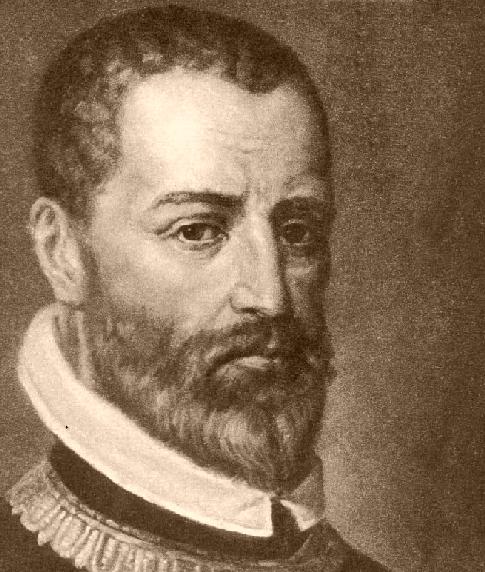
Palestrina, Italian Renaissance composer
and director of the papal choir at St. Peter's Basilica
That historic encounter, as I mentioned, took place here in this sanctuary of faith and human creativity. So it is not by chance that we come together in this place, esteemed for its architecture and its symbolism, and above all for the frescoes that make it unique, from the masterpieces of Perugino and Botticelli, Ghirlandaio and Cosimo Rosselli, Luca Signorelli and others, to the Genesis scenes and the Last Judgement of Michelangelo Buonarroti, who has given us here one of the most extraordinary creations in the entire history of art. The universal language of music has often been heard here, thanks to the genius of great musicians who have placed their art at the service of the liturgy, assisting the spirit in its ascent towards God. At the same time, the Sistine Chapel is remarkably vibrant with history, since it is the solemn and austere setting of events that mark the history of the Church and of mankind. Here as you know, the College of Cardinals elects the Pope; here it was that I myself, with trepidation but also with absolute trust in the Lord, experienced the privileged moment of my election as Successor of the Apostle Peter.
Dear friends, let us allow these frescoes to speak to us today, drawing us towards the ultimate goal of human history. The Last Judgement, which you see behind me, reminds us that human history is movement and ascent, a continuing tension towards fullness, towards human happiness, towards a horizon that always transcends the present moment even as the two coincide. Yet the dramatic scene portrayed in this fresco also places before our eyes the risk of man's definitive fall, a risk that threatens to engulf him whenever he allows himself to be led astray by the forces of evil. So the fresco issues a strong prophetic cry against evil, against every form of injustice. For believers, though, the Risen Christ is the Way, the Truth and the Life. For his faithful followers, he is the Door through which we are brought to that "face-to-face" vision of God from which limitless, full and definitive happiness flows. Thus Michelangelo presents to our gaze the Alpha and the Omega, the Beginning and the End of history, and he invites us to walk the path of life with joy, courage and hope. The dramatic beauty of Michelangelo's painting, its colours and forms, becomes a proclamation of hope, an invitation to raise our gaze to the ultimate horizon. The profound bond between beauty and hope was the essential content of the evocative Message that Paul VI addressed to artists at the conclusion of the Second Vatican Ecumenical Council on 8 December 1965: "To all of you," he proclaimed solemnly, "the Church of the Council declares through our lips: if you are friends of true art, you are our friends!" And he added: "This world in which we live needs beauty in order not to sink into despair. Beauty, like truth, brings joy to the human heart, and is that precious fruit which resists the erosion of time, which unites generations and enables them to be one in admiration. And all this through the work of your hands . . . Remember that you are the custodians of beauty in the world."
Unfortunately, the present time is marked, not only by negative elements in the social and economic sphere, but also by a weakening of hope, by a certain lack of confidence in human relationships, which gives rise to increasing signs of resignation, aggression and despair. The world in which we live runs the risk of being altered beyond recognition because of unwise human actions which, instead of cultivating its beauty, unscrupulously exploit its resources for the advantage of a few and not infrequently disfigure the marvels of nature. What is capable of restoring enthusiasm and confidence, what can encourage the human spirit to rediscover its path, to raise its eyes to the horizon, to dream of a life worthy of its vocation -- if not beauty? Dear friends, as artists you know well that the experience of beauty, beauty that is authentic, not merely transient or artificial, is by no means a supplementary or secondary factor in our search for meaning and happiness; the experience of beauty does not remove us from reality, on the contrary, it leads to a direct encounter with the daily reality of our lives, liberating it from darkness, transfiguring it, making it radiant and beautiful.
Russian novelist, Fyodor Dostoyevsky
Indeed, an essential function of genuine beauty, as emphasized by Plato, is that it gives man a healthy "shock", it draws him out of himself, wrenches him away from resignation and from being content with the humdrum -- it even makes him suffer, piercing him like a dart, but in so doing it "reawakens" him, opening afresh the eyes of his heart and mind, giving him wings, carrying him aloft.Dostoevsky's words that I am about to quote are bold and paradoxical, but they invite reflection. He says this: "Man can live without science, he can live without bread, but without beauty he could no longer live, because there would no longer be anything to do to the world. The whole secret is here, the whole of history is here." The painter Georges Braque echoes this sentiment: "Art is meant to disturb, science reassures." Beauty pulls us up short, but in so doing it reminds us of our final destiny, it sets us back on our path, fills us with new hope, gives us the courage to live to the full the unique gift of life. The quest for beauty that I am describing here is clearly not about escaping into the irrational or into mere aestheticism.
Too often, though, the beauty that is thrust upon us is illusory and deceitful, superficial and blinding, leaving the onlooker dazed; instead of bringing him out of himself and opening him up to horizons of true freedom as it draws him aloft, it imprisons him within himself and further enslaves him, depriving him of hope and joy. It is a seductive but hypocritical beauty that rekindles desire, the will to power, to possess, and to dominate others, it is a beauty which soon turns into its opposite, taking on the guise of indecency, transgression or gratuitous provocation. Authentic beauty, however, unlocks the yearning of the human heart, the profound desire to know, to love, to go towards the Other, to reach for the Beyond. If we acknowledge that beauty touches us intimately, that it wounds us, that it opens our eyes, then we rediscover the joy of seeing, of being able to grasp the profound meaning of our existence, the Mystery of which we are part; from this Mystery we can draw fullness, happiness, the passion to engage with it every day. In this regard, Pope John Paul II, in his Letter to Artists, quotes the following verse from a Polish poet, Cyprian Norwid: "Beauty is to enthuse us for work, and work is to raise us up" (no. 3). And later he adds: "In so far as it seeks the beautiful, fruit of an imagination which rises above the everyday, art is by its nature a kind of appeal to the mystery. Even when they explore the darkest depths of the soul or the most unsettling aspects of evil, the artist gives voice in a way to the universal desire for redemption" (no. 10). And in conclusion he states: "Beauty is a key to the mystery and a call to transcendence" (no. 16).
These ideas impel us to take a further step in our reflection. Beauty, whether that of the natural universe or that expressed in art, precisely because it opens up and broadens the horizons of human awareness, pointing us beyond ourselves, bringing us face to face with the abyss of Infinity, can become a path towards the transcendent, towards the ultimate Mystery, towards God. Art, in all its forms, at the point where it encounters the great questions of our existence, the fundamental themes that give life its meaning, can take on a religious quality, thereby turning into a path of profound inner reflection and spirituality. This close proximity, this harmony between the journey of faith and the artist's path is attested by countless artworks that are based upon the personalities, the stories, the symbols of that immense deposit of "figures" -- in the broad sense -- namely the Bible, the Sacred Scriptures. The great biblical narratives, themes, images and parables have inspired innumerable masterpieces in every sector of the arts, just as they have spoken to the hearts of believers in every generation through the works of craftsmanship and folk art, that are no less eloquent and evocative.
In this regard, one may speak of a via pulchritudinis, a path of beauty which is at the same time an artistic and aesthetic journey, a journey of faith, of theological enquiry. The theologian Hans Urs von Balthasar begins his great work entitled The Glory of the Lord -- a Theological Aesthetics with these telling observations: "Beauty is the word with which we shall begin. Beauty is the last word that the thinking intellect dares to speak, because it simply forms a halo, an untouchable crown around the double constellation of the true and the good and their inseparable relation to one another." He then adds: "Beauty is the disinterested one, without which the ancient world refused to understand itself, a word which both imperceptibly and yet unmistakably has bid farewell to our new world, a world of interests, leaving it to its own avarice and sadness. It is no longer loved or fostered even by religion." And he concludes: "We can be sure that whoever sneers at her name as if she were the ornament of a bourgeois past -- whether he admits it or not -- can no longer pray and soon will no longer be able to love." The way of beauty leads us, then, to grasp the Whole in the fragment, the Infinite in the finite, God in the history of humanity. Simone Weil wrote in this regard:"In all that awakens within us the pure and authentic sentiment of beauty, there, truly, is the presence of God. There is a kind of incarnation of God in the world, of which beauty is the sign. Beauty is the experimental proof that incarnation is possible. For this reason all art of the first order is, by its nature, religious."Hermann Hesse makes the point even more graphically: "Art means: revealing God in everything that exists." Echoing the words of Pope Paul VI, the Servant of God Pope John Paul II restated the Church's desire to renew dialogue and cooperation with artists: "In order to communicate the message entrusted to her by Christ, the Church needs art" (no. 12); but he immediately went on to ask: "Does art need the Church?" -- thereby inviting artists to rediscover a source of fresh and well-founded inspiration in religious experience, in Christian revelation and in the "great codex" that is the Bible.
"You are the custodians of beauty."
Dear artists, as I draw to a conclusion, I too would like to make a cordial, friendly and impassioned appeal to you, as did my Predecessor. You are the custodians of beauty: thanks to your talent, you have the opportunity to speak to the heart of humanity, to touch individual and collective sensibilities, to call forth dreams and hopes, to broaden the horizons of knowledge and of human engagement. Be grateful, then, for the gifts you have received and be fully conscious of your great responsibility to communicate beauty, to communicate in and through beauty! Through your art, you yourselves are to be heralds and witnesses of hope for humanity! And do not be afraid to approach the first and last source of beauty, to enter into dialogue with believers, with those who, like yourselves, consider that they are pilgrims in this world and in history towards infinite Beauty! Faith takes nothing away from your genius or your art: on the contrary, it exalts them and nourishes them, it encourages them to cross the threshold and to contemplate with fascination and emotion the ultimate and definitive goal, the sun that does not set, the sun that illumines this present moment and makes it beautiful.
Saint Augustine, who fell in love with beauty and sang its praises, wrote these words as he reflected on man's ultimate destiny, commenting almost ante litteram on the Judgement scene before your eyes today: "Therefore we are to see a certain vision, my brethren, that no eye has seen, nor ear heard, nor the heart of man conceived: a vision surpassing all earthly beauty, whether it be that of gold and silver, woods and fields, sea and sky, sun and moon, or stars and angels. The reason is this: it is the source of all other beauty" (In 1 Ioannis, 4:5). My wish for all of you, dear artists, is that you may carry this vision in your eyes, in your hands, and in your heart, that it may bring you joy and continue to inspire your fine works. From my heart I bless you and, like Paul VI, I greet you with a single word: arrivederci!
Christopher Hitchens. Born 13 April 1949. Died 15 December 2011. I was not familiar with this man until today, only a few days after his passing, however after reading a few articles on the man reflecting on his life and his zealous atheism, I am uncertain as to whether or not I would like him or if we would have been friends. He certainly seemed as if he was quite a likeable character even in Catholic and Christian circles. I think I would have at least held a considerable amount of respect for him. I would also like to think I understand at least some of the reasons behind his disbelief. None of these reasons may have been decisive factors, but they certainly seemed as if they were contributors to his self-dubbed "anti-theism." I would like to discuss two significant points that Hitchens made in a recent interview and their significance in evangelization. Hitchens was wrong about many things, but he was right on these two points. In an article titled Hitchens: God's Favorite Atheist? posted on the World Net Daily, author Art Moore describes an interview he had with Hitchens.
Noting that Christian evangelists say they are motivated by a desire to please God, I asked Hitchens – pointing to his "zeal" for his message – what motivates him.
"Well, intellectual scorn, really. Frankly," he said. "A sense of superiority, arrogance."
He quickly made it clear that he was speaking for himself.
"It's a feeling of just intense irritation that people are allowed to say that they are people of faith. They feel that by making this statement they have added to the argument," he said. "By announcing they believe something for no reason at all, without any evidence, they don't contribute to the discussion." (Read the full article here:Christopher Hitchens: God's favorite atheist?http://www.wnd.com/?pageId=378513#ixzz1gumXwrUi.)
Christina's World, Andrew Wyeth.
This part of the interview reminded me of a point that my ethics professor, Professor Javier Carreno, made on the first day of class last spring during my studies abroad in Austria as part of the Franciscan University Austria Program. He told us about a fashion competition that took place a few years ago during which one of the judges, a homosexual, inquired as to the reason behind the traditional views on marriage held by one of the contestants who was a Christian. The contestant responded that she believed that marriage was between a man and a woman because that was what she was raised to believe. She had been taught that her whole life. The judge replied that her reasoning was stupid. When he finishing the story, I thought my ethics professor was going to uphold the bravery of the contestant for standing up for what she believed. However, my professor said that in a way the judge was right. The reason that the girl had given for her belief was stupid. It's not enough to say that you believe something because you have been taught it your whole life. This is poor reasoning, if it could be called reasoning at all. One needs to actively wrestle with their beliefs and either reject them or take them on as their own. Christians, especially Catholics, need to take responsibility for their faith through ongoing conversion, forming themselves in their faith through philosophy and theology. Hitchens called attention to this fault in certain Christians who simply say they have faith, and think that this simple statement is good enough. Hitchens had every right to voice his irritation with such people. Catholics need to be capable of answering not only for what we believe but why we believe it.
But he said one of his "big quarrels with the Anglican church, the one in which I was baptized, is that it got rid of the King James Bible for the most part and the old hymnbook."
"They now sing and read these banal versions of [liturgy], which I used to enjoy," he said.
"I now go to an Anglican or Episcopalian ceremony, and I'm just horrified by what they've lost," he said, "what they threw away when it was unarguably a huge, aesthetic advantage."
Hitchens called attention to the need for beauty as well as truth in Catholicism. The significance of beauty in the conversion of the human person is often neglected when it comes to evangelization . . . at the expense of souls like Hitchens'. Beautiful art, beautiful music, beautiful language are what Hitchens calls "a huge aesthetic advantage." Russian author Fyodor Dostoyevsky said once, "Beauty will save the world." Pope Benedict XVI has called beauty the language of the human heart. He says, "The encounter with the beautiful can become the wound of an arrow that strikes the heart and in this way opens our eyes so that we can see the truth more clearly." Note that Hitchens specifically mentions the language of the Anglican liturgy and the music. How we pray and what music we sing at the liturgy does in fact matter. Dr. Peter Kreeft gave voice to this in a lecture he recently gave at Franciscan University titled, "How to Win the Culture War," where he mentioned an instance in which he had accompanied a Muslim friend to Mass one day. The Muslim said afterwards that while the beauty of the architecture had lifted his soul upwards, the language of the liturgy had left his soul horizontal and flat. In the same talk, Kreeft spoke of two separate atheists he knew who converted to Catholicism after hearing the music of Johann Sebastian Bach. For some people, it takes more than just the naked truth to draw them into the fold. It takes the harmonies of Faure's Requiem, the stirring use of shadow and light in a Caravaggio painting, the lofty spires of a cathedral. Benedict XVI calls sacred music "an audible and perceptible rendering of the truth of our faith. In listening to sacred music - suddenly we feel: it is true!" This is a principle that applies to all forms of art. Although the Catholic Church has always advocated the use of beautiful art as an integral part of evangelization, her support has not always been properly represented in the liturgy or recognized by bishops, priests, and laity. Fortunately, this is beginning to change. With the arrival of the new translation, the language of the Roman Rite has improved immensely. Through the work of our beloved Holy Father Pope Benedict XVI, organizations such as the Church Music Association of America and the sacred music programs of Franciscan University and Ave Maria University, sacred music is beginning to make a come back in the Church. These institutions and programs are helping artists and musicians to recognize the need to use their gifts for the conversion of souls. They are shown that it is not enough simply to create art. Rather, they must be taught the principles of beauty behind it so that they can create art and music containing the qualities of universality, goodness of form, and sanctity. I conclude with a passage from Bl. John Paul II's Letter to Artists:
Statue of St. Paul at St. Paul's Outside the Walls Basilica, Rome.
"Mine is an invitation to rediscover the depth of the spiritual and religious dimension which has been typical of art in its noblest forms in every age. It is with this in mind that I appeal to you, artists of the written and spoken word, of the theatre and music, of the plastic arts and the most recent technologies in the field of communication. I appeal especially to you, Christian artists: I wish to remind each of you that, beyond functional considerations, the close alliance that has always existed between the Gospel and art means that you are invited to use your creative intuition to enter into the heart of the mystery of the Incarnate God and at the same time into the mystery of man."
Hitchens may be counted among the victims of the rational and aesthetic impoverishments occurring within Christianity today, but I am praying and hoping that such times are coming to an end.
David Clayton, St. Thomas More College of Liberal Arts
It is such a joy for me when I discover a fellow "artist" (I would say musicians also fall under that description) who has been called to serve God through beauty, has answered that call, and has risen above the challenges such a life can encounter. I recently found such a person in David Clayton, iconographer and the Artist-in-Residence and Lecturer in Liberal Arts at St. Thomas More College of Liberal Arts. Clayton's story is intriguing in that he was not originally pursuing a career as an artist. One day a friend asked him if he was happy in his work, to which he replied that he was not, or at least that he could be happier. The friend advised him to instead pursue something that he enjoyed, something to which - if he had so much money he would never have to work again -he would be happy devoting forty hours a week. You see, God wants us to be happy in our work, so long as said work is not inherently bad. He wants you to do something that you love and enjoy, that you are passionate about. Clayton realized this as well, and with his friend's guidance was able to pursue his dream to be an artist. He took risks, but not foolish ones, focusing on one step at a time. He always kept his dream at the forefront. You can read the full story here.
Matthew Kelly,
Author of The Rhythm of Life
Clayton's story and message to people in similar situations, who want to pursue a life as an artists or really any dream, is similar to the message of a book I read during my Christmas break of 2009-2010, The Rhythm of Life by Matthew Kelly. I received this book as a gift for my high school graduation - the couple that gave it to me gives it to the high school graduates they know as an experiment to see how many of the graduates actually read it! Well, I was one of the graduates that read it - though I'll admit it took me until sophomore year of college to pick it up. But don't let that discourage you from reading it. This book changed my life! Matthew Kelly gives advice similar to that of Clayton's friend - God wants you to be happy and wants you to pursue your dream, to be who God created you to be and to do what you love to do, to thrive on what you do instead of making do with a less-than satisfactory career choice. Kelly's book gives logical steps on how to live this out through a balanced life style, caring for yourself emotionally, physically, spiritually, and intellectually. I learned how to focus on my goals, to prioritize, to pursue what I love, and to be happy and thrive vs. survive. I learned to live my dream: to serve God and people through the art of music.
A word of caution : dreams and goals don't just come to you, they must be pursued. You can wait around all you want and hope that something happens to you so that your dream is realized, but it's not that easy. Dreams and goals take sacrifice and hard work. You will be met with tough choices. The good news is that if it is something you love, then these sacrifices are worth it. And if you keep your ultimate goal at the forefront, you will be able to make your decisions accordingly. The sacrifices make the dream all the more worth it in the end - not to be cliche, but "It's not the destination it's the journey." ;-)
Bl. John Paul II, Pray for us!
The Rhythm of Life teaches you how to live a good, full life. In his Letter to Artists, Bl. John Paul II gives two definitions of artists: there are artists like Clayton who create beautiful things, but the pope also says that every personis called to be an artist in that we are all called to live a life of beauty - we are all called to become saints, to live a beautiful life for God. In short, we are all called to be artists! And Kelly shows you how to do it by helping you become what he terms "The best version of yourself." I am glad to have found someone pursuing the life of an artist in both senses of the word in David Clayton.
Here is a series of paintings of our soon to be Blessed John Paul II. His beatification will take place in Rome on May 1st, the Feast of the Divine Mercy, of which John Paul II was a strong promoter. These paintings were an exhibit in San Ruffino's in Assisi. I included the title of each painting in the caption. My favorites are Prayer, Mercy, Meditation, and God's Support. Pray for us, Papa!