Pages

Sunday, December 25, 2011

Happy Christmas!


Wishing all of my followers a blessed, beautiful Christmas!


Original artwork by Mary Sullivan
O great mystery,
and wonderful sacrament,
that animals should see the new-born Lord,
lying in a manger!
Blessed is the Virgin whose womb
was worthy to bear
Christ the Lord.
Alleluia!
Alleluia!

music by Morten Lauridsen sung at 
Westminster Cathedral, London 
for the Christmas Midnight Mass 2009


(Someday I aspire to have my own Church choir and my own Christmas Mass to plan for where we can perform this piece - this one or Louis de Victoria's version, or perhaps both!)

Wednesday, December 21, 2011

Take Him, Earth, for Cherishing - Howells


Take Him, Earth, For Cherishing is is a 4th-century poem by Aurelius Clemens Prudentius, translated by Helen Waddells. In 1963 British composer Herbert Howells was commissioned to set it to music for the memorial service in honor of John F. Kennedy. It is a beautiful memorial in honor of a departed loved one. Howells himself had lost his 9 year old son Michael to polio in 1935. He commemorated the anniversary of his son's birthday and his death in his journal every year. I am certain that he drew heavily from the loss of his son in composing the piece, as many of the musical compositions following Michael's death were deeply impacted by Howells' loss. 
Other influences on Howells seemed to have included British composer Vaughan Williams and early English choral music. I have recently begun researching Howells' in an attempt to explore his compositional styles while on break -- at least until some of my books on French Romantic organs come in at the library. I would like to get started on my music history paper before I return for my last semester. But the interlibrary loan system tends to be rather slow these days, so I'm not sure how much I'll be able to accomplish. Until then, I shall enjoy Howells, apply for organ competitions, and explore graduate school options. I am searching for a good recording of his setting of Take Him, Earth. I am enthralled by his setting of the first stanza -- what a beautifully haunting, English melody. I get a little lost towards the middle, but I think with a better recording and a few more listens I will quickly warm to the rest of it. In the meantime, check out the recording on youtube by the Boston Choral Ensemble.
Tombstone in the Zentralfriedhoff
(Central Cemetery), Vienna
Take him, earth, for cherishing,
to thy tender breast receive him.
Body of a man I bring thee,
noble even in its ruin.
Once was this a spirit's dwelling,
by the breath of God created.
High the heart that here was beating,
Christ the prince of all its living.
Guard him well, the dead I give thee,
not unmindful of his creature
shall he ask it: he who made it
symbol of his mystery.
Comes the hour God hath appointed
to fulfil the hope of men,
then must thou, in very fashion,
what I give, return again.
Not though ancient time decaying
wear away these bones to sand,
ashes that a man might measure
in the hollow of his hand:
Not though wandering winds and idle,
drifting through the empty sky,
scatter dust was nerve and sinew,
is it given to man to die.
Once again the shining road
leads to ample Paradise;
open are the woods again,
that the serpent lost for men
Take, O take him, mighty leader,
take again thy servant's soul.
Grave his name, and pour the fragrant
balm upon the icy stone.

Sunday, December 18, 2011

What Christians can Learn from an Atheist


Christopher Hitchens: God's Favorite Atheist?
Christopher Hitchens. Born 13 April 1949. Died 15 December 2011.  I was not familiar with this man until today, only a few days after his passing, however after reading a few articles on the man reflecting on his life and his zealous atheism, I am uncertain as to whether or not I would like him or if we would have been friends. He certainly seemed as if he was quite a likeable character even in Catholic and Christian circles. I think I would have at least held a considerable amount of respect for him.  I would also like to think I understand at least some of the reasons behind his disbelief. None of these reasons may have been decisive factors, but they certainly seemed as if they were contributors to his self-dubbed "anti-theism."  I would like to discuss two significant points that Hitchens made in a recent interview and their significance in evangelization. Hitchens was wrong about many things, but he was right on these two points. In an article titled Hitchens: God's Favorite Atheist? posted on the World Net Daily, author Art Moore describes an interview he had with Hitchens.

Noting that Christian evangelists say they are motivated by a desire to please God, I asked Hitchens – pointing to his "zeal" for his message – what motivates him.
"Well, intellectual scorn, really. Frankly," he said. "A sense of superiority, arrogance."
He quickly made it clear that he was speaking for himself.
"It's a feeling of just intense irritation that people are allowed to say that they are people of faith. They feel that by making this statement they have added to the argument," he said. "By announcing they believe something for no reason at all, without any evidence, they don't contribute to the discussion."
(Read the full article here:Christopher Hitchens: God's favorite atheist?http://www.wnd.com/?pageId=378513#ixzz1gumXwrUi.)


Christina's World, Andrew Wyeth.
This part of the interview reminded me of a point that my ethics professor, Professor Javier Carreno, made on the first day of class last spring during my studies abroad in Austria as part of the Franciscan University Austria Program. He told us about a fashion competition that took place a few years ago during which one of the judges, a homosexual, inquired as to the reason behind the traditional views on marriage held by one of the contestants who was a Christian. The contestant responded that she believed that marriage was between a man and a woman because that was what she was raised to believe. She had been taught that her whole life. The judge replied that her reasoning was stupid. When he finishing the story, I thought my ethics professor was going to uphold the bravery of the contestant for standing up for what she believed. However, my professor said that in a way the judge was right. The reason that the girl had given for her belief was stupid. It's not enough to say that you believe something because you have been taught it your whole life. This is poor reasoning, if it could be called reasoning at all. One needs to actively wrestle with their beliefs and either reject them or take them on as their own.  Christians, especially Catholics, need to take responsibility for their faith through ongoing conversion, forming themselves in their faith through philosophy and theology. Hitchens called attention to this fault in certain Christians who simply say they have faith, and think that this simple statement is good enough. Hitchens had every right to voice his irritation with such people. Catholics need to be capable of answering not only for what we believe but why we believe it.

But he said one of his "big quarrels with the Anglican church, the one in which I was baptized, is that it got rid of the King James Bible for the most part and the old hymnbook."
"They now sing and read these banal versions of [liturgy], which I used to enjoy," he said.
"I now go to an Anglican or Episcopalian ceremony, and I'm just horrified by what they've lost," he said, "what they threw away when it was unarguably a huge, aesthetic advantage."


Hitchens called attention to the need for beauty as well as truth in Catholicism. The significance of beauty in the conversion of the human person is often neglected when it comes to evangelization . . . at the expense of souls like Hitchens'. Beautiful art, beautiful music, beautiful language are what Hitchens calls "a huge aesthetic advantage." Russian author Fyodor Dostoyevsky said once, "Beauty will save the world." Pope Benedict XVI has called beauty the language of the human heart.  He says, "The encounter with the beautiful can become the wound of an arrow that strikes the heart and in this way opens our eyes so that we can see the truth more clearly." Note that Hitchens specifically mentions the language of the Anglican liturgy and the music. How we pray and what music we sing at the liturgy does in fact matter. Dr. Peter Kreeft gave voice to this in a lecture he recently gave at Franciscan University titled, "How to Win the Culture War," where he mentioned an instance in which he had accompanied a Muslim friend to Mass one day.  The Muslim said afterwards that while the beauty of the architecture had lifted his soul upwards, the language of the liturgy had left his soul horizontal and flat. In the same talk, Kreeft spoke of two separate atheists he knew who converted to Catholicism after hearing the music of Johann Sebastian Bach. For some people, it takes more than just the naked truth to draw them into the fold. It takes the harmonies of Faure's Requiem, the stirring use of shadow and light in a Caravaggio painting, the lofty spires of a cathedral. Benedict XVI calls sacred music "an audible and perceptible rendering of the truth of our faith. In listening to sacred music - suddenly we feel: it is true!" This is a principle that applies to all forms of art.  
Although the Catholic Church has always advocated the use of beautiful art as an integral part of evangelization, her support has not always been properly  represented in the liturgy or recognized by bishops, priests, and laity. Fortunately, this is beginning to change. With the arrival of the new translation, the language of the Roman Rite has improved immensely.  Through the work of our beloved Holy Father Pope Benedict XVI, organizations such as the Church Music Association of America and the sacred music programs of Franciscan University and Ave Maria University, sacred music is beginning to make a come back in the Church. These institutions and programs are helping artists and musicians to recognize the need to use their gifts for the conversion of souls. They are shown that it is not enough simply to create art. Rather, they must be taught the principles of beauty behind it so that they can create art and music containing the qualities of universality, goodness of form, and sanctity. I conclude with a passage from Bl. John Paul II's Letter to Artists: 


Statue of St. Paul at St. Paul's Outside the Walls Basilica, Rome.

 "Mine is an invitation to rediscover the depth of the spiritual and religious dimension which has been typical of art in its noblest forms in every age. It is with this in mind that I appeal to you, artists of the written and spoken word, of the theatre and music, of the plastic arts and the most recent technologies in the field of communication. I appeal especially to you, Christian artists: I wish to remind each of you that, beyond functional considerations, the close alliance that has always existed between the Gospel and art means that you are invited to use your creative intuition to enter into the heart of the mystery of the Incarnate God and at the same time into the mystery of man."


Hitchens may be counted among the victims of the rational and aesthetic impoverishments occurring within Christianity today, but I am praying and hoping that such times are coming to an end. 

Thursday, December 1, 2011

The Delights of Drawing Again


The semester is nearly over and soon I shall have time for posting and blogging nonsense. But until then, I thought I would post a few drawings I accomplished for my drawing class this semester. The class has proved to be a wonderful refresher. I used to draw a great deal in high school but with the dawning of college and my conversion to a musician, the other fine arts I enjoy had to be put to the side. It was a pleasant diversion to be able to have a class where instead of writing papers or reading assignments I was able to take up a pencil and attempt to create something beautiful. The first is a drawing of the woman of Samaria at the well. I call it, "It was about the Sixth Hour."


The second is a still life of the torso of a cello with a decorative trumpet and a piece of draped fabric. I was delighted with the way that the cello's reflective surface transmitted onto the paper. I didn't think it would show as well as it does!


 The third is a section of a portrait that I had to do. I was not pleased with the way in which the entire portrait turned out, but there were elements of it that I liked, such as the way that the eyes, nose, and mouth turned out.


So there are just a few things that have been occupying my time as of late. I just received more of my drawings back today, so I shall be posting more of them on my blog within the next couple of weeks, along with updates on the beauties and trials of the semester. But first, to conquer my finals and an organ studio recital! 

Friday, November 25, 2011

Real


Illustration by Rob Woodrum,
Margery William's The Velveteen Rabbit
“What is REAL?” asked the Rabbit one day, when they were lying side by side near the nursery fender, before Nana came to tidy the room. “Does it mean having things that buzz inside you and a stick-out handle?”
“Real isn’t how you are made,” said the Skin Horse. “It’s a thing that happens to you. When a child loves you for a long, long time, not just to play with, but REALLY loves you, then you become Real.”
“Does it hurt?” asked the Rabbit.
“Sometimes,” said the Skin Horse, for he was always truthful. “When you are Real you don’t mind being hurt.”
“Does it happen all at once, like being wound up,” he asked, “or bit by bit?”
“It doesn’t happen all at once,” said the Skin Horse. “You become. It takes a long time. That’s why it doesn’t happen often to people who break easily, or have sharp edges, or who have to be carefully kept. Generally, by the time you are Real, most of your hair has been loved off, and your eyes drop out and you get loose in your joints and very shabby. But these things don’t matter at all, because once you are Real you can’t be ugly, except to people who don’t understand.”
“I suppose you are real?” said the Rabbit. And then he wished he had not said it, for he thought the Skin Horse might be sensitive. But the Skin Horse only smiled.
“The Boy’s Uncle made me Real,” he said. “That was a great many years ago; but once you are Real you can’t become unreal again. It lasts for always.”
- from The Velveteen Rabbit  by Margery Williams, 1922


This was one of my favorite books during my childhood. I did not return to this book until this past summer when I read it to my sister as a bedtime story and was moved to tears by the tragic beauty of it. I had forgotten what a bittersweet tale Margery Williams' book was. It is certainly on of those children stories that C.S. Lewis would have designated as a "good" children's story, as it is appropriate for adults as well as children in its beautiful message. The book follows the relationship of a toy rabbit and his loving child owner from its beginning to its conclusion. The rabbit becomes the child's favorite plaything only to eventually be cast aside. 
The velveteen rabbit shows where true beauty really lies -- not in appearance, for the longer he is loved by the boy the more tattered and worn he appears. On the contrary, Real lies in loving until it hurts, and being loved by another. The same can be said of people -- the people who dare to live and to love, even if it hurts. These people love come what may -- partings, illness, death, hurt. REAL people, as described by the Skin Horse, are those who have been tattered and torn yet still dare to live and to dream. They have been hurt deeply and they have loved deeply, their hands are gnarly and wrinkled from caressing the heads of children and wiping away tears and sweat. Their joints are achy from lifting a helping hand to assist both neighbor and stranger, from dancing with their spouse, parent, child, from rocking children and grandchildren to sleep. Their mouths are lined from years of smiles, laughter, singing, speaking words of blessing and encouragement. Real people are those who have the courage to get up to face the mundane tasks of life and to sacrifice for their loved ones, to speak the truth and to live it. After all, the fate of the rabbit himself may actually be similar to the one we will experience at the end of our life. Perhaps it may be said that after our death in eternity we shall "become Real." Perhaps that is where life truly begins. If this is true, I hope that one day that I shall, like the velveteen rabbit, become Real. 

Tuesday, October 18, 2011

Happy Feast Day to St. Luke!

I still have 43 minutes to celebrate the feast day of St. Luke, so I thought I would do it by putting up a photo of his attributed masterpiece, Our Lady of Czostachowa, one of the Black Madonnas. According to legend, this beautiful image of the Madonna and Child was painted by St. Luke on the wood of a table built by Christ. The image has been nearly stolen by pagans and desecrated, yet she is still there, gesturing to her son. Some of the desecrations are still miraculously visible, namely the marks on her face. The monks tried to repair the image but any paint that was applied to the area refused to remain. She is known as the Queen and the Protector of Poland for saving the monastery of Jasna Gora from Swedish invaders in the mid-1600s. Jasna Gora is now her home, and I had the privilege of visiting her in February 2011. Ever since that visit I have had a very strong devotion to her, and I have St. Luke to thank for it! Pray for us, St. Luke, and pray for the artists and the doctors of the world!


Saturday, October 15, 2011

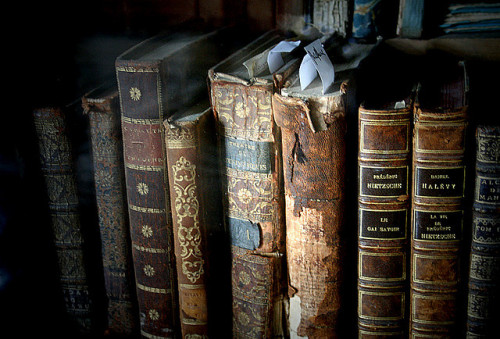
On Libraries, Books, and Kindles

Danielle: It makes me want to cry. 
Henry: Pick one. 
Danielle: I could no sooner choose a favorite star in the heavens. 
Henry: What is it that touches you so? 
Danielle: I suppose it is because when I was young my father would stay up late and read to me. He was addicted to the written word and I would fall asleep listening to the sound of his voice. 
Henry: What sort of books? 
Danielle: Science, philosophy... I suppose they remind me of him. He died when I was eight. Utopia was the last book he brought home. 
Henry: Which explains why you quote it. 
Danielle: I would rather hear his voice again than any sound in the world. 
[Henry smiles, then the smile fades and he begins walking down the stairs away from Danielle] 
Danielle: Is something wrong? 
Henry: [turns to face her] In all my years of study, not one tutor ever demonstrated the passion you have shown me in the last two days. You have more conviction in one memory than I have... in my entire being. 
[laughs slightly, walks away, Danielle follows] 
Danielle: Your Highness, if there is anything I have said or done... 
Henry: Please... don't. It's not you.


THis is one of my favorite scenes in the chick flick Ever After, where Prince Henry takes Danielle to the library at a nearby Franciscan friary. I usually tend to dislike chick flicks, but this one carries a special place in my heart. First of all, it's a fairy tale, a Cinderella-retelling, so some of the outrageous things that occur like falling in love within a matter of days doesn't bother me. Second, it's a great portrayal of what a female role in a relationship should be: Danielle is confident in herself, she possesses self-knowledge and this is part of what draws Henry to her. She calls Henry on to become a better person while not being overbearing, and he rises to the occasion. Plus the scenery and the costumes are just beautiful, there's two scenes of beautiful chant and polyphony, there's Leonardo DaVinci (he's the fairy godmother character, LOL), there's sports, true love! What more can you ask for? ;-)
Anyway... I'm bringing up this whole topic because today during the liturgical conference held on campus, Dr. Bergsma gave a lecture on the nuptial and liturgical orientation of salvation history. During the section on the bridegroom imagery of the Old Testament, Bergsma compared the bridegroom Isaac to the well-beloved, popular protagonist, Mr. Darcy from Pride and Prejudice. He specifically mentioned the scene where Lizzie begins falling in love with Mr. Darcy after seeing his magnificent estate. Bergsma said she was drawn to his wealth, but I disagree. Wealth was a part of it, for sure -- a woman likes to see that a man can provide for a wife and a family. It's a definite plus! But it was more so the fact that it now becomes apparent to Lizzie that Darcy is a man of taste and a man of class. The scene in Ever After is a bit different from this incident with Lizzie and Darcy. At Danielle and Henry's first encounter, it seems that Henry doesn't have much appreciation for literature, or at least not for St. Thomas More's Utopia. But his lakc of appreciation is what makes their little field trip to the library even sweeter, in a way, because he's trying to branch out and appreciate her interests. He's trying to gain some "class"-standing in her eyes, and I think it does work. Personally, it would have been rather difficult for me to resist Henry's intentions if I were taken on such a date: books, Franciscan friars, a beautiful cloister, and chant, beautiful chant. I mean, what's not to like? Especially if you're a nerd like me? FYI to all ye men in want of a wife, women do appreciate men with class, even if the women themselves don't appreciate it! ;-)
And another point : I didn't intend to add this point but I'm going to anyway, a plug for books vs. kindles that was made by roommate and one of my best friends who is also an English major. Now, I'm not going to say that kindles should be obliterated from the face of the earth because they do have their uses and their advantages -- however, I DO think that the world is going to experience a grave impoverishment if books and book binding are lost for the sake of creative destruction, and I think this scene and a similar scene in Beauty and the Beast prove this. What do you think would have happened if Prince Henry had taken Danielle to a digital library? Would it have been as moving an experience? In the Disney classic Beauty and the Beast when the Beast shows Belle his beautiful library and gives it to her, do you think she would have been as impressed?  There is something about the physicality of a thing that rings true within our souls. It's similar to how we are beings composed of body and soul, physical as well as spiritual. I suppose it is similar to the experience of going to see the Messiah performed live as opposed to listening to a recording of it from itunes. It's beautiful and it can still move you, but it's not quite the same as being in the concert hall and thrilling at the "Alleluia" chorus. Similar to a book vs. a kindle: the kindle still communicates the words to you, but it's not quite the same as smelling the pages of the book and feeling the cover between your hands. It's a more personal experience! It will be a sorry existence that bids farewell to the physicality of a book.


I conclude with a quote about libraries:

“A library is a good place to go when you feel unhappy, for there, in a book, you may find encouragement and comfort. A library is a good place to go when you feel bewildered or undecided, for there, in a book, you may have your question answered. Books are good company, in sad times and happy times, for books are people - people who have managed to stay alive by hiding between the covers of a book.” --E.B. White