Pages

Friday, August 16, 2019

Stranger Things, Broken Things, & Billy Hargrove


Stranger Things, Season Three
As soon as the release date was announced for the third installment in the Stranger Things series, my siblings and I made plans that we were all coming home for the July 4th holiday and we were going to spend our vacation together binging the newest installment in our latest obsession, complete with Eggos and Reese's Pieces.


Now, if you haven't seen season three yet and want to avoid spoilers, stop reading now. This is your one and final warning. If you haven't seen any Stranger Things and plan to watch it, stop reading. If you don't care, keep reading and I hope you change your mind. 


SPOILER ALERT

The creators of Stranger Things, the Duffer Brothers, are phenomenal writers who know how to craft beautiful, three-dimensional characters and carefully plotted story arcs rooted in the great themes of classical mythology. Much like the hobbits in The Lord of the Rings or the Harry-Ron-Hermione trio of the Harry Potter series, a party of nerdy kids in Hawkins, Indiana remind us of the beauty of friendship, love, courage, and loyalty as they face fearful odds and terrifying monsters. Indeed, to paraphrase G.K. Chesterton, Stranger Things is true not because it tells us that monsters exist, but because it tells us that monsters can be beaten. 

These themes have been central to all three seasons of the show. However, a new theme was given center stage in season three: the theme of redemption as represented in the storyline of Billy Hargrove. 

The theme of redemption isn't new to Stranger Things, as Steve Harrington also undergoes a similar transformation over the course of seasons one and two. However, it can be argued that Steve's choices in season one were motivated primarily by selfishness and immaturity. 

By contrast, the Duffer Brothers characterize Billy as truly malevolent: he bullies his step sister Max and nearly runs over her friends with his car; he is a bigot and a liar; and he attempts to destroy the Wheeler family by trying to seduce the mother, Karen, who is clearly unhappy in her marriage. (Granted, he seems to be motivated more by lust and perhaps boredom than by a desire for revenge. Regardless, he is clearly up to no good.) 

Nevertheless, the writers are careful to maintain the humanity of their new villain. A brief exchange between Billy and his father towards the end of season two indicates that Billy's angry, volatile behavior is the result of verbal, physical, and emotional abuse. While this does not justify his actions, it contextualizes him for the audience.

Billy Hargrove, played by Dacre Montgomery

The Fall

In season three, the Mind Flayer attempts for the second time to assert its dominion over our world. While it cannot yet take physical form, it can use its influence to lure or capture unsuspecting victims and then subject them to its will. Billy is at the wrong place at the wrong time and, in the basement of an abandoned warehouse he becomes the second human victim possessed by the monster. Billy then becomes the primary tool through which the Mind Flayer subtly “recruits” additional human hosts until it amasses an army of what become known as “The Flayed.”

It’s not long before the AV Club of Hawkins Middle School & Co. realize that the Mind Flayer is back, that Billy is under its control, and it is building an army to destroy Eleven, the people of Hawkins, and the world as they know it.

Eleven, as played by Millie Bobby Brown

In Episode 6, Eleven attempts to locate Billy by reaching out to him via the astral plane. She finds herself on a California beach, where she witnesses a tender scene between ten-year-old Billy and his mother. This is followed by a series of pivotal moments over the course of his youth where Eleven observes the devastating impact of an abusive father on the troubled, angry young man she and her friends are trying to save.

Unfortunately, Eleven’s attempt to reach out to Billy compromises her position, and the Mind Flayer tracks her and her friends all the way to Starcourt Mall, where through a mysterious turn of events she is stripped of her supernatural powers. Although her friends attempt to shield her from the clutches of the Mind Flayer, they are no match for the Billy and the monster.

The Resurrection

As Billy presents a battered Eleven to the Mind Flayer, Eleven makes one last attempt to reach out to him. In one of the most beautiful moments in the entire show, she reminds him of his memory of his mother watching him play on the beach. She appeals to the goodness buried within him as represented in his love for his mom. Knowing Billy’s past of terrible suffering and trauma, and simultaneously drawing on her own experience of the loss of her mother, Eleven not only breaks through to him but also inspires him to turn and face the Mind Flayer, buying enough time for Hawkins’ heroes to close the Gate and defeat the monster. This costs Billy his life, and yet Billy Hargrove dies an unlikely hero in one tremendous sacrificial act.

Conclusion

J.R.R. Tolkien once wrote, “A divine ‘punishment’ is also a divine ‘gift,’ if accepted, since its object is ultimate blessing, and the supreme inventiveness of the Creator will make ‘punishments’ (that is changes of design) produce a good not otherwise to be attained.”

This does not mean that Our Lord wills for evil or tragic things to befall us, or that we should desire such things. Rather, it means that God allows in His providence and grace for us to experience suffering in order that a greater good might be brought forth, as the broken body of Christ on Calvary brought forth the redemption of mankind.

The fate of Billy Hargrove serves as a powerful example of this divine phenomenon. If Billy had never been possessed by the Mind Flayer, he may never have had the desire for the good or the courage to become a hero. But his brokenness -- the desperation, loss, and fear that he felt from being possessed by the Mind Flayer -- opened him up to receive Eleven’s reaching out to him. She reawakened in him the memory of his love for his mother, helping him find the courage to stand in the gap and become a hero.

Similarly, it is only when Eleven is broken and stripped of her supernatural gifts that she is able to call Billy on to heroism through the power of empathy and love. If it were not for the loss of her powers, Billy might not have had a chance at redemption.

To quote the Venerable Fulton Sheen, “Broken things are precious. We eat broken bread because we share in the death of Our Lord and His broken life. …A broken ship saved Paul and many other passengers on the way to Rome. Sometimes the only way the good Lord can get into some hearts is to break them.”

A broken Eleven saved Billy, and a broken Billy saved the world.

In the breaking of Billy Hargrove, and the pouring of his lifeblood out upon the floor of Starcourt Mall, there was a gift, and that gift was a resurrection: the saving of Billy’s soul, for no greater love has a man than to lay down one’s life for one’s friends.

Saturday, July 27, 2019

The Lion King 2019 is the Stuffed Dog We Never Wanted


I am not opposed to the recent Disney trend of live-action re-imaginings of animated films, at least not in theory. There are many old Disney movies that can be and have been improved upon, such as Cinderella, Pete's Dragon, and The Jungle Book. The originals of the aforementioned films are rather mediocre, and so rejuvenating them through new technology and better storytelling was not only enjoyable but also laudable. [Other animated Disney movies that should be remade that would be amazing: Atlantis. Please!]

However, it's much more difficult when you start remaking original Disney films that were smashing successes, such as the 1991 Beauty and the Beast, which was nominated for Best Picture that year, or the 1992 Aladdin, which was the highest grossing film of all time until …

The Lion King.

I loved The Lion King. I still love The Lion King -- the original. And so, I wasn't happy when I found out that one of my top three favorite movies was next in line for the Disney live-action makeover treatment.

That being said, I admit to being pleasantly surprised by Bill Condon’s Beauty and the Beast (2017) remake, which added dimension to some of the characters who felt flat in the original: specifically, the Beast, LeFou, Maurice, and Gaston. We came to know the Beast’s personality and backstory little more, LeFou wasn’t pure slapstick and Maurice was more than a bumbling idiot, and Gaston was truly malevolent. The new songs were well written, and the animation was gorgeous. It wasn’t a perfect movie, but it filled out some of the missing pieces of the original and I have found I still enjoy it after several viewings.

However, The Lion King is a greater movie than Beauty and the Beast. The music is amazing. The animation is breathtaking, both the landscapes and the poignant expressiveness of the animated characters.  The storytelling is tight -- you can almost conduct the dialogue, the music, and the cinematography as it flows seamlessly from the savannah to the jungle to the perilous gorge. The emotional journey cuts right to the quick of the need for the individual to nobly shoulder their responsibilities in spite of wickedness and tragedy, in contrast to the bitter resentment of Scar and the hyenas, or the nihilistic "Hakuna Matata" lifestyle of Pumba and Timon which, while catchy, leads to boredom, emptiness, and despair.

In short, it would be extremely difficult to find things in the original that could be improved upon, unless the film chose to go in a different direction that did NOT include a shot-for-shot, line-for-line homage to the original. However, Disney chose to do the latter.

The live-action Lion King taught me three things about the original film:

1. Realism in this case meant sacrificing the emotional impact. The anthropomorphic expressivity of the animated characters is a significant component to the emotional drive of the original story: Baby Simba’s adorable pouting, his large yellow eyes welling up with tears, Scar’s menacing sneer, Mufasa’s noble brows, Rafiki’s maniacal jests – all of these are lost to realism. As I was watching the live-action version this past weekend, many of the lines which were supposed to pack a punch felt flat because of the lack of emotion in the “live-action” characters’ facial expressions.

The Lion King, 2019.

2. Timing is everything. A friend of mine and a fellow musician once told me that a good movie should feel like you are conducting an orchestra. There are natural cadences, moments were the action and the music surge forward and then pull back.
This is harder to describe in words, but as a musician I felt as though the timing felt off for many of the lines and even the pacing of some of the scenes. Perhaps this wouldn’t have been as noticeable if we weren’t comparing it to the original film even if only in our subconscious. But here we find ourselves.

The Lion King, 1994.

3. The live-action film adaptation had to narrow its scope, especially during the musical numbers. Delightful sequences from “I Just Can’t Wait To Be King” lose some their charm as the vivid background patterns (inspired by African color palates and designs) are omitted because of the naturalistic look. Similarly, time lapse sequences from “Hakuna Matata” where the characters meander through the jungle, jumping into lagoons and sauntering across giant water falls in the moonlight are reduced to three realistic animals trotting through the jungle and singing, which is acceptable but nowhere near as imaginative or exciting.

Very often in new technological advances, there is something that must be sacrificed for the sake of these new developments. One good artistic example of this can be found in the development of violin strings. Originally made entirely of sheep/lamb gut (termed “catgut”), gradually metal and gut were combined, and then gut was supplanted by metal altogether in the early 20th century. While metal strings were more durable and produced a louder sound, they cannot achieve the same colors and tonal qualities of gut strings, making the latter more desirable to students and performers of earlier styles of music such as J.S. Bach. Similarly, the realism of the new adaptation of The Lion King sacrifices the emotional journey and the imaginative scope of the original for realism.

During my freshman year of college, my English Professor told us a story about a parent who, upon the death of the family dog, had the animal stuffed by a taxidermist to comfort his distraught child. Naturally, the experiment was rejected because certain things cannot be manufactured in a lab or a studio: relationship, love, nostalgia. Similarly, Disney’s live-action Lion King is the stuffed version of your pet dog that you never wanted in the first place. The movie may be interesting for the first fifteen minutes, but the viewer quickly realizes that the heart is missing and becomes bored.

Tuesday, June 25, 2019

Thirty-Six Compelling Films that Can Spark Good Conversations about Catholicism

The phrase "Catholic film" gets thrown around a lot in conversation these days. However, in my opinion, a truly Catholic film is one that is beautifully made from a technical and artistic standpoint, and tells the truth about the moral and spiritual order in a compelling manner.


One of my biggest pet peeves are Catholic books and films that are backed by good intentions but are either poorly made and/or are too niche. Often these films and books are intended as tools for evangelization, but in the end they speak only to Christian and/or Catholic audiences.

So over the course of the past several years I have compiled a list of movies that I would not be embarrassed to show to my non-Catholic and non-Christian friends. These films draw from a variety of genres and film eras, and so I am hopeful that folks will find something for everyone.

Lady Bird, 2018.
Also, please know that just because I think a film is Catholic does not mean it is necessarily family friendly i.o.w. devoid of explicit sexual content, foul language, or violence. I strongly recommend looking up the parental guidelines on IMDb (International Movie Data Base) before watching these films, especially with children.

Also, please let me know of other films you would recommend as beautiful, truth bomb-dropping, compelling, not-embarrassing Catholic films!

A Man for All Seasons, 1966
The Lord of the Rings, 2001-2003
Up, 2009
Becket, 1964
Lady Bird, 2018
Darkest Hour, 2018
Indiana Jones & The Last Crusade, 1989
Indiana Jones & the Raiders of the Lost Ark, 1981
Calvary, 2014
I Confess, 1953
The Sound of Music, 1965
On the Waterfront, 1954
Chariots of Fire, 1981
Brideshead Revisited, 1981
Stranger Things, 2016-2019
Into Great Silence, 2005
The Painted Veil, 2006
Angels with Dirty Faces, 1938
Lilies of the Field, 1963
The Way, 2010
The Secret Life of Walter Mitty, 2013
Iron Man, 2008
Yours, Mine, and Ours, 1968
It’s a Wonderful Life, 1946
The Lion King, 1994
Juno, 2007
Sleeping Beauty, 1959
Life is Beautiful, 1997
The Prince of Egypt, 1998
True Grit, 2010
Boys Town, 1938
The Giver, 2014
Les Miserables, 1998
The Rookie, 2002
The Trouble with Angels, 1956
The Avengers, 2012


Avengers: Endgame, 2019.

Sunday, June 9, 2019

Twelve Rules for Life is Helping Me Strive for Sainthood

This past spring I finished reading Jordan B. Peterson's book Twelve Rules for Life. Prior to reading his book, I had started watching and listening to his lectures on YouTube and his podcast in the Fall of 2018.


Jordan Peterson is changing my life, and that is not a hyperbole. 

In the first installment of The Hobbit film trilogy (this whole production was a travesty, in my opinion, but this quote was a good moment and it is true to the heart of Tolkien's mythology), Gandalf the Wizard states, "Saruman believes it is only great power that can hold evil in check, but that is not what I have found. I find that it is the small everyday deeds of ordinary folk that keep the darkness at bay: small acts of kindness and love."

The concept of the agency and potential of the individual to bring about good is at the heart of
Peterson's book. He reinforces the value of the ancient concept that, while life is full of tremendous suffering and is tainted by malevolence, the best path forward is when the individual courageously takes up the daily tasks and responsibilities put before him and bears them in a courageous, truthful manner to the best of his ability.


He further argues that the pursuit of happiness a.k.a. pleasure will not in fact fulfill you. Instead, he states that the best path towards a good life consists of the pursuit of meaning through taking up as much responsibility in your life as you possibly can carry. One example he gives for this is having and raising children. Some people reject the idea of having children because they think that it will make them unhappy.

Peterson does not disagree with this.

Yes, if you have a child you will be more stressed, you will have more anxiety, and you will relinquish a good deal of your freedom, time, energy, and other assets. However, you will find life far more fulfilling than it would have been if you had never had that child. There are precious few things in life that are more beautiful and meaningful than bringing a new life into the world and nurturing it into a kind and courageous human being.


Speaking for myself, Peterson's book is changing the way I live my life for the better. As a church musician, I have a very demanding job that also permeates many aspects of my personal life. I love what I do, but it's exhausting and I rarely get a break. However, I am in a position where I am capable of nourishing the spiritual lives of a lot of people through the music and liturgy at my parish, and that is tremendously fulfilling, and so if I am able to take on more responsibilities and projects to make our church's music program better, than the thing that will actually make me happier is not the beer waiting at home for me in my fridge, or binge watching that new show on Amazon or Netflix. It will be nurturing a better choir, educating more children in sacred music, and worshipping our Lord all the more in beauty and joy.

Now, that doesn't mean that you should give all you got with reckless abandon -- Peterson cautions against this in his second chapter/rule: "Treat yourself like you would someone you are responsible for helping." You need to take care of yourself now so that you can become the person you are meant to be, and that means going to the doctor, asking for help when you need help, living a healthy lifestyle, telling the truth, and so forth.

Following Peterson's advice, I am trying to be more careful in my actions, my thoughts, and my speech. I am trying to take responsibility for myself, my house, and my community in the little ways that I can. I am trying to be a better person than the person I was yesterday -- that is to say, more truthful, kinder, and braver. Listening to his podcast this past week (a recording of a lecture he gave in Vancouver on July 26, 2018) gave me the push I needed to give up something "precious" to me that I recently realized I needed to let go of but didn't have the strength to do until now.

Peterson's book shows small practical ways that you can move towards bettering first yourself, then your relationships within your family, and then your community. It is almost incredibly simple, extremely practical, but also beautiful. Using his knowledge of biology and psychology, philosophy, Scripture, and literature, Peterson draws from and illuminates deep truths that humanity has known for thousands of years but seems to have lost or forgotten until recently. I am not sure, but I think his book is helping me to become a better person. Coupled with God's grace in the sacraments, it is helping me to strive more earnestly for sainthood.

Sunday, May 12, 2019

Tolkien (2019): A Review

This past Saturday I went to see the new Tolkien film directed by Dome Karukoski and produced by Fox Searchlight Pictures.

Allow me to preface this by saying that I was obsessed with the Peter Jackson's The Lord of the Rings films when I was in high school and college. Those films, while flawed, were my gateway to the majestic world of Middle Earth and all of its beautiful characters. Since then, I have grown to see the superiority of the books, and I count them among my top ten favorite literary works. And while I am hardly a Tolkien scholar, I hold him in high regard and admire him not only as a great writer and linguist but also as an ardent Roman Catholic. In sum, I went into this film expecting to be greatly disappointed.

I was wrong.

 I enjoyed many aspects of the film immensely. The cinematography was wonderful, and the incorporation of the many fantastical elements through phantom-like appearances of knights on horseback, dragons, and so forth, combined with a gorgeous soundtrack by Thomas Newman, transported me to the world of Faerie in a wonderful way.

Another one of the strengths of the film was the camaraderie amongst Tolkien and his classmates. During his time at Saint Edward's School, Tolkien and several classmates formed an unofficial society titled the "Tea Club, Barrovian Society," also known as the T.C.B.S. According to the film, the group would meet at the tea shoppe, Barrow Stores, and discuss art and literature and critique one another's work (a precursor of the future Inklings). Their friendship and their love of art bore a wonderful resemblance to the poetry club established in the well-known Robin Williams' film, Dead Poets' Society.

SPOILERS BEGIN

Favorite moments? 1) One of the early scenes when the two Tolkien brothers are play-acting with their mother, Mabel; 2) the TCBS scenes when they are kids walking through the streets shouting their battle cry; 3) Edith dancing amongst the trees (this scene was far too short; I needed more of this magic in my life); 4) all the little scenes of Tolkien sketching his creatures from his imagination -- I love that the director pointed to the fact that Tolkien was an artist as well as an author; 5) the opera scene with Edith. These are just a few of the delightful moments and they exceeded my expectations in many respects!

SPOILERS END

My chief criticism is the lack of attention to Tolkien's faith, which was heavily influential on his life, both circumstantially and personally, and on his literary works. For those who may not know, Tolkien's father died when Tolkien was about three. Five years later, his mother Mable Tolkien, raised Baptist, converted to Roman Catholicism, resulting in her family withholding all financial assistance. This left the Tolkien family completely destitute save for the charity of the Catholic Church. Tragically Tolkien's mother passed away from acute diabetes in 1904 (Tolkien was about 12). Before her death, Mabel entrusted the care and upbringing of her sons to her friend, Father Francis Morgan of the Birmingham Oratory.

These events left a deep impression on Tolkien as evidenced by the quote written about nine years after his mother's death: "My own dear mother was a martyr indeed, and it is not to everybody that God grants so easy a way to his great gifts as he did to Hilary and myself, giving us a mother who killed herself with labour and trouble to ensure us keeping the faith."

SPOILERS BEGIN

There is a moment in the film where Father Morgan criticizes Tolkien's romantic pursuit of his childhood friend, Edith, because she is not a Catholic. This comment falls short because it has been poorly contextualized. What could have been a moment of heightened drama for Tolkien, both in regards to his relationship with the priest and in regards to his relationship with his faith as a practicing Catholic, falls flat.

END SPOILERS

The director and writers chose to focus more on the friendships established in the TCBS; while there was plenty of material here as well, nevertheless, I think the lack of attention to his Catholic faith was a missed opportunity for a great subplot.

In conclusion, I enjoyed the film considerably. If I were to rate it in comparison to Peter Jackson's The Lord of the Rings films and The Hobbit Trilogy, I would agree with the Prancing Pony Podcast hosts, Alan and Shawn, placing it slightly higher than An Unexpected Journey.  I heartily recommend going to see the film if you are a Tolkien fan!

In the meantime, I will be listening to this Thomas Newman soundtrack ad nauseum.

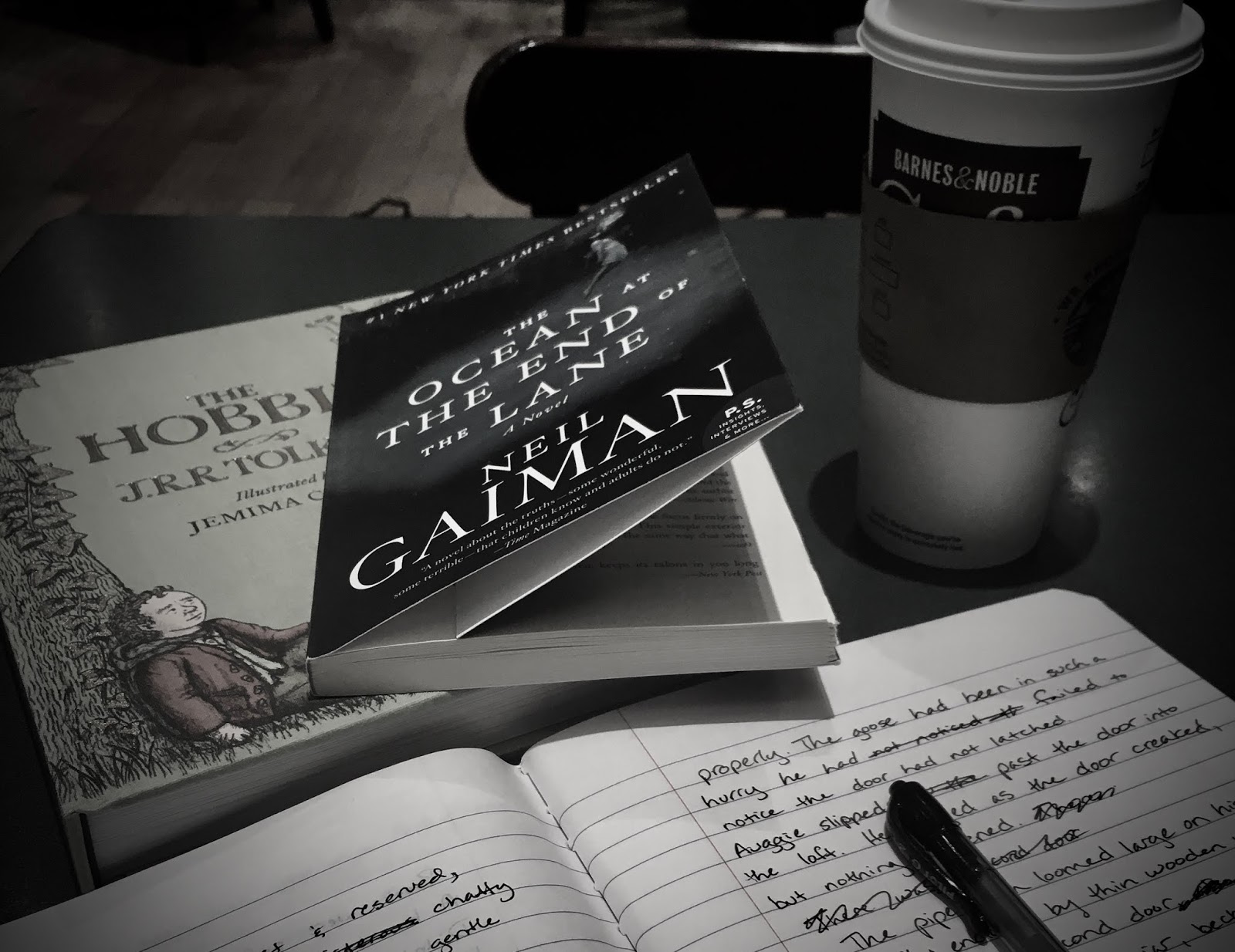
P.S. You don't have to take my word for it: best-selling author and die-hard Tolkien fan Neil Gaiman also recommends the film!


Friday, February 8, 2019

Lettie Hempstock & Tom Bombadil


In Neil Gaiman's adult fairy tale, The Ocean at the End of the Lane, an ordinary little boy encounters a girl and her family who identify themselves as the Hempstocks.

The little girl, Lettie Hempstock, lives on a nearby ramshackle farm with her mother and grandmother. At first glance, Lettie and her family seem like humble, simple folk, wise and warm and generous. In a brief exchange at the beginning of the story, Lettie reveals that she and her family are not at all what they seem:

"Once you've been around for a bit, you get to know stuff."

I kicked a stone. "By 'a bit' do you mean 'a really long time'?"

She nodded.

"How old are you, really?" I asked.

"Eleven."

I thought for a bit. Then I asked, "How long have you been eleven for?"

She smiled at me.

-- Neil Gaiman, The Ocean at the End of the Lane: Chapter 3.

After a few more similar cryptic exchanges between the little boy and the Hempstock family, it is readily apparent that the Hempstocks are not only much older than they look, but perhaps even of another world.

Nevertheless, like most families there is tension amongst the family members. While the mother and grandmother choose to observe the world from a distance, Lettie's modus operandi is to to take action. She sees the evil forces threatening the little boy and his family, and chooses to combat them, at great risk to herself and others.

As I was reading this passage I could not help but think of the similarity between Neil Gaiman's  Hempstock family and Tom Bombadil from J.R.R. Tolkien's The Lord of the Rings. When the hobbits first encounter Bombadil in the Old Forest, he seems like a jolly, carefree fellow. He is described as "Master of Wood, Water, and Hill", at home among the birds and the beasts as he leads a quiet, pleasant life by the river with his beautiful wife, Goldberry.

However, similar to the Hempstocks, it becomes clear that Bombadil knows more than he lets on. Behind his jolly visage there are hints of great age, knowledge, and even power. Bombadil tells Frodo and his companions that he was present when the Elves first came West, and Lord Elrond of Rivendell later confirms that Bombadil was considered old during the Elder Days (a.k.a. the First Age of Middle Earth. The Lord of the Rings takes place during the Third Age, making Bombadil thousands of years old).

What is truly remarkable about Bombadil is his indifference to and even authority over the One Ring. He is not the least bit affected or tempted by its power, and seems more concerned about tending his own lands than in the Ring. In addition, he can see Frodo when Frodo puts the Ring on, and he can wear the Ring himself with no effect, even making the Ring disappear and reappear at will.

Nevertheless, similar to the older generations of the Hempstock family, Bombadil prefers to remain aloof from the plight of those around him, even though he realizes the gravity of the situation which threatens Middle Earth. While Bombadil rescues the hobbits first from the cantankerous Old Man Willow and later from the malevolent Barrow-wights, he does not involve himself in Frodo and Gandalf's quest beyond this point.

What are we to make of this type of lifestyle? In a modern western culture where the trite adage "With great power comes great responsibility," is upheld, the Bombadil option is a difficult mode of existence to understand or accept.

However, when Tolkien was asked about Tom Bombadil's role (or lack thereof) in The Lord of the Rings, he responded:

"The story is cast in terms of a good side, and a bad side, beauty against ruthless ugliness, tyranny against kingship, moderated freedom with consent against compulsion that has long lost any object save mere power, and so on; but both sides in some degree, conservative or destructive, want a measure of control. But if you have, as it were, taken 'a vow of poverty,' renounced control, and take your delight in things for themselves without reference to yourself, watching, observing, and to some extent knowing, then the questions of the rights and wrongs of power and control might become utterly meaningless to you, and the means of power quite valueless...  

It is a natural pacifist view, which always arises in the mind when there is a war ... the view of Rivendell seems to be that it is an excellent thing to have represented, but that there are in fact things with which it cannot cope; and upon which its existence nonetheless depends. Ultimately, only the victory of the West will allow Bombadil to continue, or even to survive. Nothing would be left for him in the world of Sauron."

Perhaps the roles of the characters of Bombadil in The Lord of the Rings and the Hempstocks in The Ocean at the End of the Lane may be likened to the need for the contemplative as well as the active roles in our communities. The historian or the theologian is just as significant as the soldier. The librarian is just as essential as the policeman. The cloistered nun reciting prayers on her beads in a chapel, walled from the world, is just as essential as the parish priest ministering at the sick bed, on the battlefield, and in the sanctuary. We need the preservers of culture just as much as we need the defenders.

Monday, January 21, 2019

January: Drawing Close to Those on the Other Side

January is a tough month for my family, in both the ecclesial and in the biological sense.

Yesterday was the anniversary of my maternal grandfather's death. My Grandpa was a great grandpa, my confirmation sponsor, and a good pal. He could strike up a conversation with anyone, but he kept it real. He was one of the hardest working people I have ever known. He loved Johnny Cash, Clint Eastwood, John Wayne, and Aragorn from The Lord of the Rings movies. He used to heckle me about my (first) crush on Legolas (my tastes have matured since then, LOL) and about how that guy never seemed to run out of arrows (he had a fair point). He loved animals, cats and dogs alike. He loved ice cream and walks on the beach. He loved music, and while he wasn't a huge fan of classical music he certainly appreciated it, and he loved to hear me play the pipe organ. Bach's Prelude & Fugue in A Minor, BWV 543, and Durufle's Prelude & Fugue on the name of Alain were the last pieces I played for him. My favorite memories are playing Phantom of the Opera or Rigoletto for him on the piano in the living room, or sipping coffee with him in the early morning at the kitchen table in my grandparents' house. We are different people, but he was salty, and I have gotten far saltier in my old maidenhood, and I think he would enjoy that.

Yesterday was also the Feast of Saint Agnes, Virgin & Martyr. I went to Mass, and afterwards I reflected upon how, at the reception of Holy Communion, our departed loved ones are closest to us, how the veil between this world and the next becomes transparent and our souls are almost touching. And so I prayed for him and for all those in our families who have gone ahead of us. I prayed for their eternal rest and peace, and I asked for their prayers for those of us still fighting the fight here on earth.

And it made me think of those of our family, sometimes in the biological and always in the ecclesial sense, that we never had the chance to meet in this life -- namely the unborn, who are numbered among the Church Triumphant (meaning they are automatically considered saints according to Church teaching). I am talking not only of siblings lost through miscarriage but also the friends, family members, class mates, team mates, (the list is endless really) lost through abortion.

Today is the anniversary of Roe v. Wade, and it is a difficult day to mark. But it is also a day of hope. For as we fight for the rights of the unborn of all those who are vulnerable, we remember that the unborn, now numbered among the Church Triumphant, are also fighting for us through intercessory prayer. And so, we greet the anniversary of Roe v. Wade with a unique and strange attitude, for in the words of T.S. Eliot, we "rejoice and mourn at once."

Halfway through Eliot's play, Murder in the Cathedral, the poet reflects through the voice of Saint Thomas Becket on the extraordinary juxtaposition of Christmas Day and the Feast of Saint Stephen, Martyr.  He writes:

"Is it an accident, do you think, that the day of the first martyr follows immediately the day of the Birth of Christ? By no means. Just as we rejoice and mourn at once, in the Birth and in the Passion of Our Lord; so also, in a smaller figure, we both rejoice and mourn in the death of martyrs. We mourn, for the sins of the world that has martyred them; we rejoice, that another soul is numbered among the Saints in Heaven, for the glory of God and for the salvation of men."

May we remember to draw close through prayer to those who are on the other side of the veil: our family, our friends, the holy men and women and children who have gone on ahead of us. And we remember that they, too, are drawing close and praying for us. We do not fight our battles alone.