Pages

Showing posts with label The Lord Of The Rings. Show all posts

Friday, February 8, 2019

Lettie Hempstock & Tom Bombadil


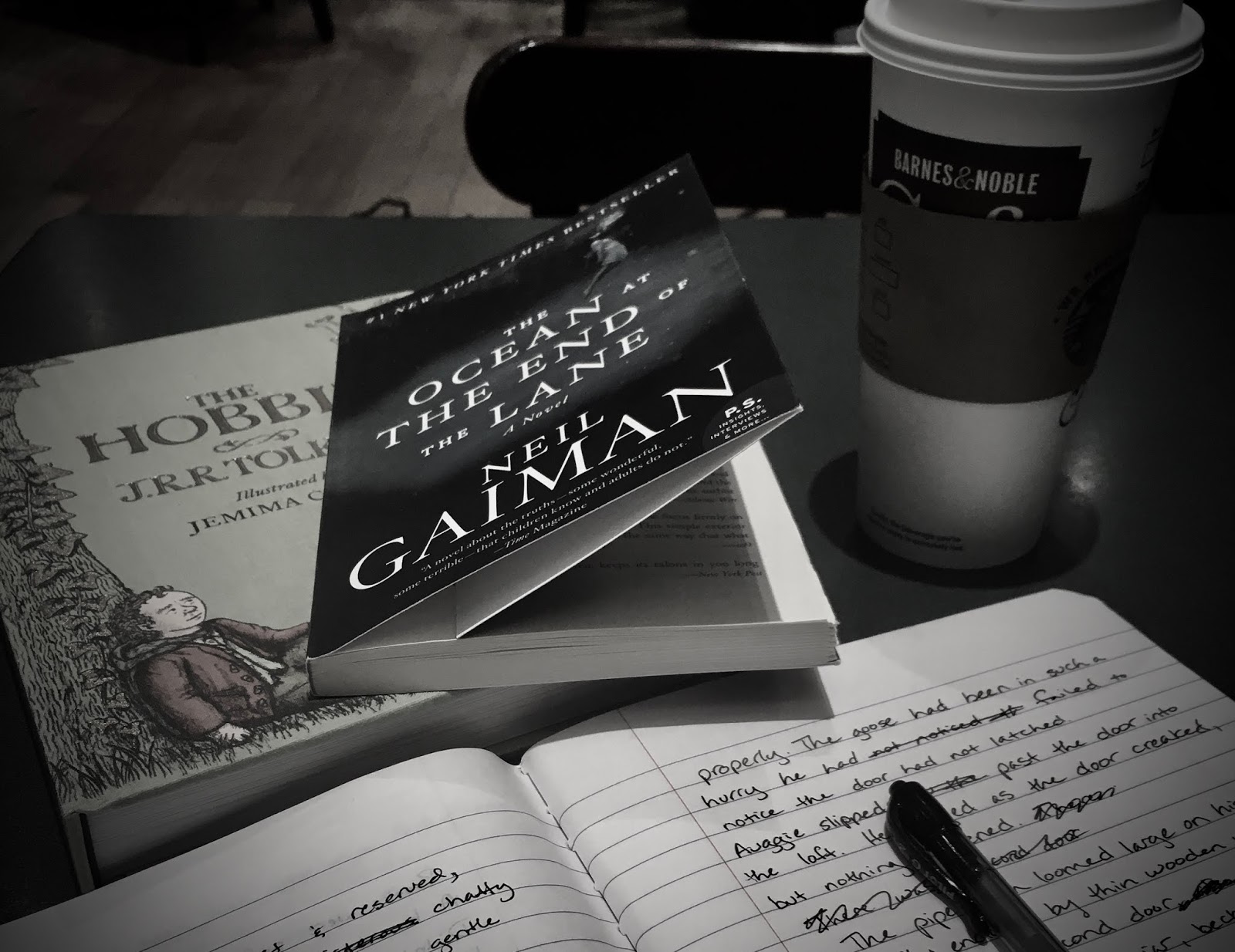
In Neil Gaiman's adult fairy tale, The Ocean at the End of the Lane, an ordinary little boy encounters a girl and her family who identify themselves as the Hempstocks.

The little girl, Lettie Hempstock, lives on a nearby ramshackle farm with her mother and grandmother. At first glance, Lettie and her family seem like humble, simple folk, wise and warm and generous. In a brief exchange at the beginning of the story, Lettie reveals that she and her family are not at all what they seem:

"Once you've been around for a bit, you get to know stuff."

I kicked a stone. "By 'a bit' do you mean 'a really long time'?"

She nodded.

"How old are you, really?" I asked.

"Eleven."

I thought for a bit. Then I asked, "How long have you been eleven for?"

She smiled at me.

-- Neil Gaiman, The Ocean at the End of the Lane: Chapter 3.

After a few more similar cryptic exchanges between the little boy and the Hempstock family, it is readily apparent that the Hempstocks are not only much older than they look, but perhaps even of another world.

Nevertheless, like most families there is tension amongst the family members. While the mother and grandmother choose to observe the world from a distance, Lettie's modus operandi is to to take action. She sees the evil forces threatening the little boy and his family, and chooses to combat them, at great risk to herself and others.

As I was reading this passage I could not help but think of the similarity between Neil Gaiman's  Hempstock family and Tom Bombadil from J.R.R. Tolkien's The Lord of the Rings. When the hobbits first encounter Bombadil in the Old Forest, he seems like a jolly, carefree fellow. He is described as "Master of Wood, Water, and Hill", at home among the birds and the beasts as he leads a quiet, pleasant life by the river with his beautiful wife, Goldberry.

However, similar to the Hempstocks, it becomes clear that Bombadil knows more than he lets on. Behind his jolly visage there are hints of great age, knowledge, and even power. Bombadil tells Frodo and his companions that he was present when the Elves first came West, and Lord Elrond of Rivendell later confirms that Bombadil was considered old during the Elder Days (a.k.a. the First Age of Middle Earth. The Lord of the Rings takes place during the Third Age, making Bombadil thousands of years old).

What is truly remarkable about Bombadil is his indifference to and even authority over the One Ring. He is not the least bit affected or tempted by its power, and seems more concerned about tending his own lands than in the Ring. In addition, he can see Frodo when Frodo puts the Ring on, and he can wear the Ring himself with no effect, even making the Ring disappear and reappear at will.

Nevertheless, similar to the older generations of the Hempstock family, Bombadil prefers to remain aloof from the plight of those around him, even though he realizes the gravity of the situation which threatens Middle Earth. While Bombadil rescues the hobbits first from the cantankerous Old Man Willow and later from the malevolent Barrow-wights, he does not involve himself in Frodo and Gandalf's quest beyond this point.

What are we to make of this type of lifestyle? In a modern western culture where the trite adage "With great power comes great responsibility," is upheld, the Bombadil option is a difficult mode of existence to understand or accept.

However, when Tolkien was asked about Tom Bombadil's role (or lack thereof) in The Lord of the Rings, he responded:

"The story is cast in terms of a good side, and a bad side, beauty against ruthless ugliness, tyranny against kingship, moderated freedom with consent against compulsion that has long lost any object save mere power, and so on; but both sides in some degree, conservative or destructive, want a measure of control. But if you have, as it were, taken 'a vow of poverty,' renounced control, and take your delight in things for themselves without reference to yourself, watching, observing, and to some extent knowing, then the questions of the rights and wrongs of power and control might become utterly meaningless to you, and the means of power quite valueless...  

It is a natural pacifist view, which always arises in the mind when there is a war ... the view of Rivendell seems to be that it is an excellent thing to have represented, but that there are in fact things with which it cannot cope; and upon which its existence nonetheless depends. Ultimately, only the victory of the West will allow Bombadil to continue, or even to survive. Nothing would be left for him in the world of Sauron."

Perhaps the roles of the characters of Bombadil in The Lord of the Rings and the Hempstocks in The Ocean at the End of the Lane may be likened to the need for the contemplative as well as the active roles in our communities. The historian or the theologian is just as significant as the soldier. The librarian is just as essential as the policeman. The cloistered nun reciting prayers on her beads in a chapel, walled from the world, is just as essential as the parish priest ministering at the sick bed, on the battlefield, and in the sanctuary. We need the preservers of culture just as much as we need the defenders.

Tuesday, December 18, 2012

There and Not Quite Back Again: Thoughts on An Unexpected Journey

I remember when I first watched The Fellowship of the Ring with my mom at my grandparents' house and what a thrilling moment that was.  It was the beginning of a love affair with a film trilogy that I believe aptly captures the heart of Tolkien's story, even if Peter Jackson did take some significant liberties from the plot line.  In the film adaptions, I believe that the characters came to life on screen as if they had walked off of the pages of The Lord of the Rings (with the exception, perhaps, of Faramir, but that's a discussion for another day). And the filmmakers did justice to Tolkien in portraying the scarred albeit beautiful world of Middle-earth.

When Peter Jackson announced that he would be continuing his work of bringing Tolkien's world to the silver screen, I was elated. When he later announced that he was going to split the story into three films instead of two while also including a great deal of material from the appendices of The Return of the King, I was a bit surprised and not surprised at the same time: surprised because I was still unsure how they were going to draw out the story of The Hobbit into three movies, even with filler from the appendices, and not surprised because Peter Jackson doesn't know how to make a small film project. "Go big or go home." I suspected that the story might suffer from this extension.

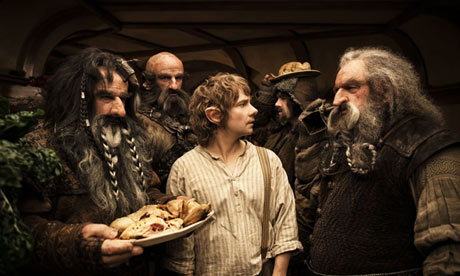
I went to see the film last Saturday with my roommate and I confess that I was disappointed. However, some things were nailed right on the head. First of all, I don't think anyone could have done a better job portraying Bilbo Baggins (besides Ian Holm) than Martin Freeman, who is well known for his role as the faithful, level-headed John Watson in the modern BBC adaption of Sir Arthur Conan Doyle's Sherlock Holmes. Steven D. Greydanus, film critic and creator of Decent Films Guide, describes Freeman's portrayal of Bilbo Baggins as "less interesting" than Ian Holm's in his review of the film. I would disagree here. Freeman's Bilbo was quaint, timid, and charming -- perhaps too timid, and here I would agree with Greydanus that Freeman's Bilbo seems more willing to be seen as a coward than Tolkien's Bilbo, who defends his honor thusly:

"I don't pretend to understand what you are talking about, or your reference to burglars, but I think I am right in believing" (this is what he called being on his dignity) "that you think I am no good. I will show you.  ... I am quite sure you have come to the wrong house. ... But treat it as the right one. Tell me what you want, and I will try it, if I have to walk from here to the East of East and fight the wild Were-worms in the Last Desert." (J.R.R. Tolkien, The Hobbit)


I also thought it was out of line with Bilbo's character for him to attempt to leave the company, especially after he had signed the contract (which was NOT in the original story). Bilbo seems to be the sort of fellow who would honor a contract regardless of ill feelings from his leader. These are my only complaints about Bilbo. His annoyance with Gandalf and his bewilderment when the dwarves first arrive at his home is hilarious and his humor and simple courage is heart warming. This is what we love about our hobbits.

It was nice to see some of the dwarves besides Thorin receive some individuality as well. Tolkien doesn't provide much of this for his readers, which is understandable when you have thirteen to keep track of, but I still appreciated this perk.

The film had some magical moments, for certain. One of my favorites (and I think a favorite for most movie goers) was the scene "Riddles in the Dark," the signature scene of The Hobbit where Gollum and Bilbo first meet. This scene still contained liberties: 1) the omission of the "birthday present" reference which is included in The Return of the King prologue but was somehow forgotten here, and 2) the interpolation of Gollum's schizophrenic personality into a scene where it was not originally emphasized. However, it was believable and masterfully acted! Another favorite moment was a moment referenced in The Fellowship of the Ring. At one point in Moria, Gandalf admonishes Frodo that it was pity that prevented Bilbo from killing Gollum. "Do not be too eager to deal out death and judgement. The pity of Bilbo may rule the fate of men." We see this moment played out before us in An Unexpected Journey. We see Bilbo's temptation to kill Gollum and the pity that stays his hand.

Three other great scenes:  1) when Bilbo defends himself against Thorin: "I know you doubt me. You always have. ... You don't have a home. It was taken from you, but I will help you take it back if I can." Well said, Bilbo. You've done your people proud. 2) When Thorin begins to respect Bilbo at the end of the film. 3) When Gandalf explains his reason for choosing Bilbo, "Saruman believes that it is only great power that can hold evil in check. That is not what I've found. I find it is the small things, everyday deeds of ordinary folk, that keep the darkness at bay. Simple acts of kindness and love. Why Bilbo Baggins? Perhaps it is because I am afraid and he gives me courage." This seemed very much in character with Gandalf, which brings me to my complaints with Jackson's adaption.

Gandalf did not seem as authoritative as he is in The Lord of the Rings or The Hobbit for that matter. He is usually the one with the answers, working behind the scenes.  But when Radagast comes to Gandalf and the dwarves (which was added) and later at the council at Rivendell, Gandalf seems unfamiliar with the activities of the Necromancer (a.k.a. Sauron), which is definitely contrary to the book and, I thought, Gandalf's character.  In the very first chapters of The Hobbit, Gandalf mentions the awakening of the Necromancer to Thorin. In Unfinished Tales, Tolkien further explains that this was part of the reason why Gandalf sought out Thorin and Bilbo Baggins.

While Radagast was charming as a character, I also felt his added role of distracting wargs and orcs and  such was anywhere from unnecessary to a little over the top.

The White Council (the council among Gandalf, Elrond, Saruman, and Galadriel) seemed unconvincing.  There were moments like this in Harry Potter that played out far better.  Here I felt like I was watching something out of the second Star Wars trilogy... ugh... painful. And speaking of cheap, Azog was also a major disappointment. Granted, Azog did exist in Tolkien's head, but was beheaded by Thorin's cousin, Dain. I can see why Peter Jackson would include him. The story needs a villain since Smaug is absent for the length of story covered in the first part.  But if that is the case, than perhaps it was a poor decision to extend the story into three films.  Better that than bring back supposedly dead villains that come off as the product of a cheap fantasy novel.

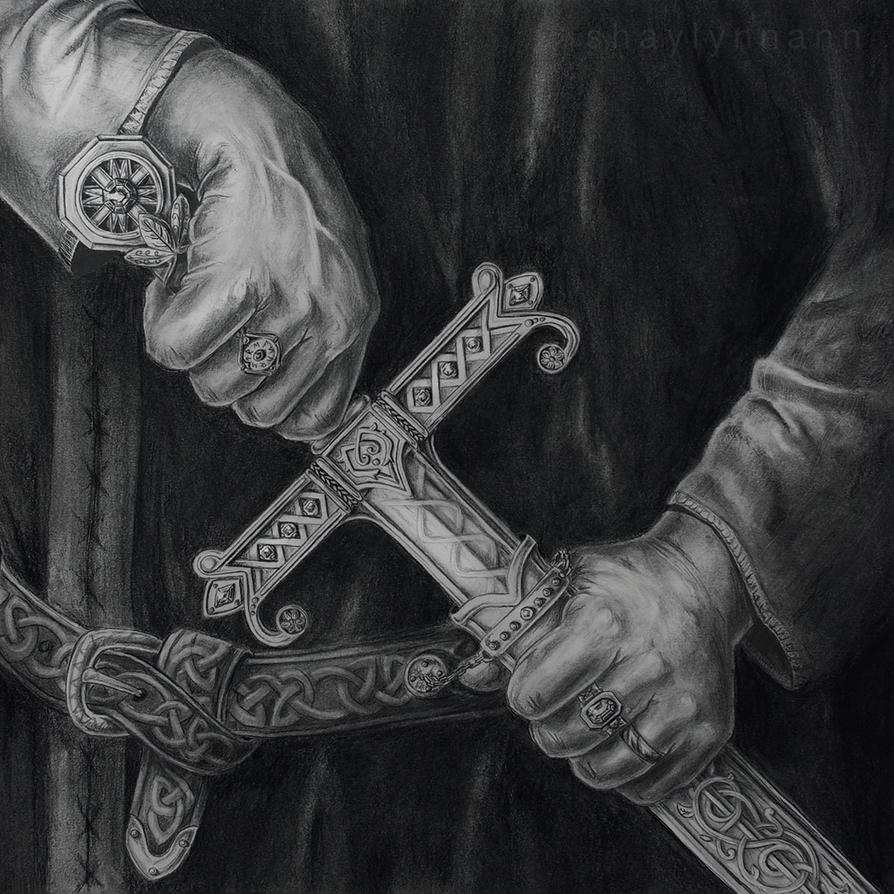
"From the Dragon's Hoard" by Shaylynn Anne
from Deviantart
But that brings me to the subject of The Hobbit compared to The Lord of the Rings as novels. The Hobbit is much whimsical than The Lord of the Rings. Jackson seems to be making The Hobbit into an epic when it's nature is more akin to a fairy tale with its light hearted, simplistic touches.  There are some more child-suited moments, to be sure, with the slapstick humor of the dwarves. But the battle scenes are just as grotesque and grand-scale as its more mature counterpart. And even then, it seems like there is something lacking. The battles came off as a little ridiculous at parts -- I'm thinking specifically of the Goblin Town escape, which seemed almost laughable compared to the Moria sequence, which was described by Jeff Overstreet as akin to the best action scenes in Indiana Jones' Riders of the Lost Ark. Greydanus says if this is true, "the Goblin-town fight plays like the silliest stunts from Indiana Jones and the Temple of Doom."

Greydanus describes The Lord of the Rings films as "full of bombast, but also brilliance, and moments of quiet grace, subtlety, and joy." There was sweeping grandeur, but there was also an abundance of simple beauty and sensible substance to back it up. For example, the exchange between Aragorn and Boromir in Lothlorien, or Sam's longing for the Shire on the slopes of the Mount Doom. Although Bilbo expresses his longing for home at the end of the movie, it would have been nice to see have seen or heard more of this as the story progressed, little moments of greatness.

That being said, it is a good action-adventure fantasy film and I will probably see it and enjoy it more than once.  Nevertheless, I think I am beginning to understand my purist friends and how they feel about Jackson's The Lord of the Rings. I felt the same with the Narnia films, particularly The Lion, the Witch, and the Wardrobe. There were moments where the filmmakers were able to capture the magic of the story, but this time around the magic seemed much more illusive than it was in Jackson's prior adaptions of Tolkien literature. I'll finish by saying that while I am more reluctant to see other adaptions of The Lord of the Rings, I'm looking forward to a second try at The Hobbit, at least part I.

Saturday, August 14, 2010

Where Is The Horse & The Rider?

A song Aragorn recites about Rohan in J.R.R. Tolkien's The Two Towers:

Where now the horse and the rider? where is the horn that was blowing?
Where is the helm and the hauberk and the bright hair flowing?
Where is the hand on the harp-string, and the red fire glowing?
Where is the spring and the harvest and the tall corn growing?
They have passed like rain on the mountain, like a wind in the meadow;
The days have gone down in the West behind the hills into shadow.
Who shall gather the smoke of the dead wood burning?
Or behold the flowing years from the Sea returning?

A section of this song is sung by King Theoden in Peter Jackson's version of the film in an eerie scene which takes place in the king's chamber prior to the Battle of Helm's Deep.

Where is the horse and rider,
Where is the horn that was blowing
They have passed like rain on the mountain
Like wind in the meadow
The days have gone down in the West,
Behind the hills, into Shadow...