Pages

Tuesday, October 16, 2012

Why Singing Sacred Music is Like A Magical Wardrobe

The transition from studying sacred music at a solid Catholic university to studying music at a secular conservatory has certainly been an interesting one. One of the keenest differences is obviously the change from a predominantly Christian atmosphere to one where there is seldom any outward expression of religious belief of any kind. Although my fellow organ students and I are certainly exposed to many religious compositions through our internships at various Christian denominations -- presbyterian, episcopalian, catholic, etc. -- I would say the vibes of the studio overall are also largely secular.

By now you're probably thinking, "Well, of course, it's going to be secular! It's a school full of liberal musicians!" 

Haha, yes, I was aware of that even before Day #1. So why am I bringing this up? 

St. Mark's Basilica, Venice, Italy
I was recently placed in an interesting scenario that struck me as particularly disjunct from my previous musical experiences in undergrad. This semester I have been working with an ensemble of early music singers who are performing a great deal of music by Italian composer Giovanni Gabrieli. Gabrieli was the principal organist at Saint Mark's Basilica in Venice and wrote a great deal of sacred choral works as well as secular instrumental works. Many of the pieces which this ensemble is singing are sacred works, such as his setting of "Miserere Mei Deus," which is also known as Psalm 51.

What is Psalm 51? It is a prayer, a cry to God which King David wrote when he was at one of the lowest moments of his life. He committed adultery with Bethsheba, he murdered her husband, and he had lost a son because of his sins. In this particular psalm he is asking God to forgive him.

"Have mercy on me, O God, according to your great mercy. ... For I know my iniquity, and my sin is always before me. Against you, you alone, have I sinned, and have done evil in your sight ... You shall sprinkle me with hyssop, and I shall be cleansed: you shall wash me, and I shall be made whiter than snow. ... Create in me a clean heart, O God: and renew a right spirit within me. Cast me not away from your face; and take not your Holy Spirit from me." 

Sitting in on the rehearsals behind my little continuo organ watching these students and fellow musicians sing this piece, it struck me as odd that for a significant number of these singers, it was quite possible that the words made little difference to them. Yes, they cared about the inflection and the strong-weak syllables, the pronunciation, the musical notation, etc. in short *how* the text was set.  But I wonder how much consideration they put into the meaning of the words: that what they are singing is also a timeless prayer, a cry of love, remorse. It's not just music, singing, it can be an expression of something so much deeper! 

Lucy and Mr. Tumnus from
The Lion, The Witch, and the Wardrobe
By C.S. Lewis
This scenario seemed ironic to me.  When one is singing sacred music, there is certainly a level of beauty that is readily apparent, in this case the music which Gabrieli composed to adorn the text. This music, this type of beauty, could be said to be a universal language -- most human beings, even atheists, will admit that they are moved by such beautiful music. It speaks to them in a way that is more easily understood.

But there is another type of beauty that was already there, that of an honest plea to God, which the Holy Spirit inspired King David to utter in his hour of darkness. It is a sacred text, timeless, inspired by God. And even though the musical setting is indeed wonderful, the words are what inspired the composer. The text and its Author are what make the music sacred in the first place. They transcend the musical adornment. This kind of beauty is not readily apparent to the casual listener/singer.  There is a level of religious devotion -- shall I call it love? -- a disposition of the heart which the singer needs in order to appreciate this level of beauty. 

It so happens that while I was mulling this all over in my head, I was in the middle of a Chronicles of Narnia kick (I go through these from time to time, now I'm on Harry Potter)-- listening to the music, reading quotes, posting C.S. Lewis and the like all over my tumblr, etc. And somehow, these two came together in what I though was a fascinating analogy. 

Lucy Pevensie, played by Georgie Henley in
Disney's The Lion, The Witch, and the Wardrobe

Do you remember the scene in The Lion, The Witch, and the Wardrobe in which Lucy Pevensie encounters the wardrobe and she first walks through to the land of Narnia, full of magical landscapes, fauns, and tea parties?  Later in the story, she tries to show this world to her older siblings, but all they see is the back of a wardrobe.  I would pose that singing sacred music is like encountering this magical wardrobe. Some musicians sing Psalm 51, Mass texts, chant, Palestrina, etc. and find themselves in Narnia -- not literally, of course, but because their hearts and minds are disposed through love to prayer, they experience the musical settings of these sacred texts on a far more intimate level. Other musicians sing these pieces and, while they admire the manner in which the piece has been composed, all they see is the wooden back of a wardrobe.

So is it better to be a Christian and sing sacred choral music? I would venture that, while it may not always be the case, it most definitely can be!

Saturday, September 29, 2012

Classical Music: The Ultimate Rebel

Some words from concert violinist Hilary Hahn on classical music 
and its ability to transcend time and culture.


I have realized something recently about classical music, something that both surprises and delights me. As a player, I have a constant backdrop of classical music in my thoughts and in my inner soundtrack, and there is unlimited potential for discovery within this music’s history and ongoing offerings. Like most people who are reading these words, I fell for the works, the emotions, the directness, and the nebulousness within classical music long ago.
"Afternoon Memories' by darkmello from Deviantart

But this thing that I realized about classical music has little to do with any of that. It is rather that classical music is the ultimate rebel. This overarching body of work kicks butt so much, and has such seniority over us, that it does not care whether any one person likes it or not. It will be what it will be. Its composers will write what they will write. It does not need to cater to us any more. By now, it is greater than the sum of our human contributions, and that is terrific! Despite this, it humors us. It lets us practice and theorize; it enriches our commutes and our evenings in and our evenings out; it runs through our heads taunting us; it brings infamy to its creators and challenges to its interpreters; it teases us, amuses us, makes statements, and generally does its own thing while allowing listeners and performers to see themselves in it. All the while, classical music — this messy, brilliant, ever-evolving giant of a genre — encompasses a uniqueness that we hope to retain. It is beautiful, and it is unpredictable."

-- Hilary Hahn, “Celebrate Classical Music: I Love Classical Music.” September 6, 2012 at 3:51 pm.

Saturday, August 25, 2012

My New Tumblr!

Greetings, readers! I recently started my graduate studies, so between moving, orientation, and adjusting to city-life, posting on my blog has been temporarily put on hold, though I hope to post again very soon. In the meantime, I wanted to let you know that I recently started a Tumblr titled "The Gleaner," which you can access here: http://cecilia37.tumblr.com. Please tune in for your daily dose of beauty varying from art, music, and architecture to landscapes and literature! The name of my Tumblr comes from the famous Realist painting "The Gleaners" by Jean-Francois Millet, pictured at the top, and is meant to reflect my desire to be a gleaner of truth and beauty in all of its forms, via the written word, the chisel, the paint brush, or God's creation. Happy tumblr-ing!


Wednesday, July 25, 2012

Da Vinci's Madonna & Child with St. Anne, and Bach's St. Anne Prelude & Fugue


Today is the feast day of St. Anne, and what better way to celebrate than through art!  To commemorate the day, I am posting the masterpieces of two of the most prominent names in both the art world and at large: Leonardo da Vinci and Johann Sebastian Bach!

Renaissance artist Leonardo da Vinci presents portrays in the sketch below the Blessed Mother and the Infant Christ Child alongside St. Anne, the mother of the Blessed Virgin. This detail is part of a larger sketch which also portrays the infant St. John the Baptist. For this reason, I find it rather odd that the other woman is designated as St. Anne rather than St. Elizabeth, the mother of St. John. But perhaps there is a significant detail I am missing that reveals her to be St. Anne, or perhaps da Vinci himself designated her as St. Anne to avoid the confusion of future generations.

Detail of Madonna and Child with St. Anne and the Young St. John by Leonardo da Vinci
This second piece of art is Bach's Prelude and Fugue in E-flat Major, also known as the St. Anne Prelude and Fugue. The title of St. Anne comes from the melody of the same name, which appears as the fugue subject -- the principal melody upon which the piece is built -- in the second movement of this baroque masterpiece. The first movement consists of three parts and is meant to reflect the three persons of the Holy Trinity. Of course, in my opinion, listening to "Our Holy Father Bach" (in the words of French Romantic organist Charles-Marie Widor) is a perfect way to celebrate any occasion, but today especially he seems appropriate!


Sunday, July 15, 2012

Quotes from Brideshead Revisited

I just finished Evelyn Waugh's Brideshead Revisited and thought I would celebrate by sharing a few quotes. Each quote describes something about one of the characters in the story. If you haven't read it, I highly recommend it! I've put the quotes in italics. Below each quote are some reflections I've had while reading, which you can skip if you don't like spoilers.


Sebastian Flyte:
...its a rather pleasant change when all your life you've had people looking after you, to have someone to look after yourself. Only of course it has to be someone pretty hopeless to need looking after by me.” 

I found it rather intriguing to find these words coming from Sebastian: Sebastian, the Oxford student who drinks too much and used to carry around a teddy-bear; Sebastian who despises his mother and his family. Yet, it may be an instance of the masculine tendency towards providing. Men like to have the answers. They want able to provide for their wives, girlfriends, and/or families. Sebastian didn't have the opportunity to really experience this until he'd fled his family and met Kurt.
Another interesting point I found was where Sebastian finally settles down: living half-in, half-out of an abbey. When I first read the title of Book II, "A Twitch Upon the Thread," I had a difficult time wrapping my head around it. However, as the story progressed, I realized that it was just as fitting as the first title. The title comes from one of G.K. Chesterton's Father Brown stories. Cordelia speaks of it at the end of Book I. Fr. Brown says that he has his subject on a hook so that the man might go to the farthest corner of the earth, yet Fr. Brown can bring him back with "a twitch upon the thread." The same can be said of the fallen away members of the Flyte family, such as Sebastian. Sebastian remarked in Book I about how difficult it was to be Catholic. Charles dismisses it as nonsense, to which Sebastian responds, "Is it? I wish it it were." After Sebastian has disappeared, Cordelia confides to Charles,"I used to think Sebastian had [a vocation] and hated it--but I don't know now." He may have been running away from a vocation, and has finally stopped. This is all speculation on my part. But whether or not he actually had a vocation, he couldn't run away from his faith, either. He had his wild days, but eventually he came back.

Diana Quick as Julia Flyte
and Charles Keating as Rex Mottram in BBC's adaption
Julia about Rex Mottram:
He wasn't a complete human being at all. He was a tiny bit of one, unnaturally developed; something in a bottle, an organ kept alive in a laboratory. I thought he was a sort of primitive savage, but he was something absolutely modern and up-to-date that only this ghastly age could produce. A tiny bit of a man pretending to be whole.

Rex Mottram is quite a character, albeit an unattractive one. Julia met and married Rex in the hopes of finding happiness and prestige with him. At first, Rex intended to become Catholic in order that their marriage might be recognized by the Church. However, once the Flyte family discovers that he was previously divorced and his ex-wife is still living, marriage within the Catholic Church becomes impossible. Once he realizes that becoming Catholic isn't going to bring him a life with Julia, he drops it completely. Against the wishes of her Catholic family, Julia decides to reject her faith for life with Rex.  However, life with him doesn't turn out the way she thought it would. Soon after their marriage, Julia finds out that Rex has been continuing an affair with another woman, whom he had been seeing during their courtship. (This sent up warning flags for me, but apparently it didn't for Julia). When Julia confronts him about it, he is unable to see why she is so upset. I'm not sure how on earth a man could become practically devoid of feeling, but it certainly seems to have happened in the case of Rex Mottram. I believe he has a very small soul locked away in an iron safe located in his big toe.

Julia Flyte:
I've always been bad. Probably I shall be bad again, punished again. But the worse I am, the more I need God. I can't shut myself out from His mercy. ... Or it may be a private bargain between me and God, that if I give up this one thing I want so much, however bad I am, He won't quite despair of me in the end.”

Jeremy Irons as Charles Ryder
Julia is rather similar to Sebastian in that she, also has had her wild days. Both she and Sebastian know that they are living in sin. Julia rejected her faith in pursuit of happiness when she married Rex in spite of his previous divorce. When life with Rex doesn't turn out the way she had hoped, she runs away to America. When she takes up with Charles, both have been disillusioned by their first love and by their ambition. Julia wants to marry Charles, but something is holding her back.  In her lifestyle she denies her faith, but in her heart she can't. At one point she undergoes a bout of hysterics over her sinful lifestyle. As I read her monologue, she seems to have an excessive focus on sin. It appears that she doesn't believe that God will forgive her, so there is no use asking for His mercy. There seems to be no turning back. However, both her faith and Charles' faith are tested when Lord Marchmain comes home to Brideshead to die. It is at the moment of death that the real drama is acted. It all comes down to what one believes.  Life. Death. The fall from grace. The possibility of redemption. Julia realizes through the example of her father, another fallen away Catholic, that redemption is possible. If so, Julia realizes that there may be hope even for her. A twitch upon the thread... The final quote is from my favorite scene in the book. I won't say any more, lest I spoil the ending for you.

Charles Ryder:
Then I knew that the sign I had asked for was not a little thing, not a passing nod of recognition, and a phrase came back to me from my childhood of the veil of the temple being rent from top to bottom.


Wednesday, July 4, 2012

Brideshead Revisited: Catholic with a Universal Appeal

This summer a group of friends and I have been reading British author Evelyn Waugh's Brideshead Revisited. Each week we have a new reading assignment and then we'll discuss it amongst ourselves on a blog we set up just for the occasion. 


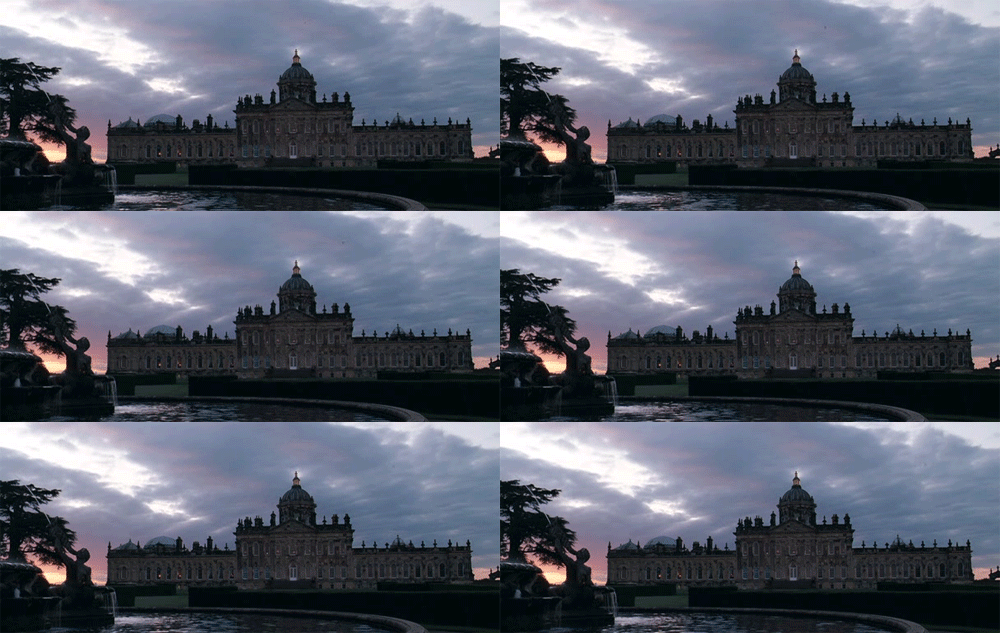
Castle Howard, North Yorkshire
served as the location for filming Brideshead
 in both the miniseries and the 2009 adaption.

In case you are unfamiliar with the story, Brideshead Revisited consists of a series of memories of British commander Charles Ryder, which are triggered by his battalion's encampment at a large abandoned estate known as Brideshead. These memories revolve around Ryder's relationship with a Roman Catholic aristocratic family in England in the 1920's. Evelyn Waugh also described this work as semi-autobiographical, recounting memories from his own years at Oxford. Waugh converted to Catholicism in the year 1930 after the failure of his first marriage.
Though Catholicism serves as one of the central themes of the story, it appeals to people of all beliefs (as evidenced by the fact that it is in top 100 lists of secular publications). For example, Waugh is one of the favorite authors of Fr. Robert Barron, a Catholic priest well known for his work in the "Catholicism" series, as well as the recently deceased British atheist, Christopher Hitchens. Why does a universal audience appreciate this novel when many non-Christians reject so many Christian stories? First of all, it is a well-crafted piece of literature! The writing style and the descriptions are beautiful, elegant, and poetic. Good art -- in this case, good writing -- appeals to a universal audience, regardless of background and belief. You can be a Budhist, an atheist, or a Catholic and still find the Sistine Chapel inspiring! In this case, we are dealing with literature not painting, but the truth still stands. As a quick example, I'm including a passage from the beginning of Book II:


"The human soul enjoys these rare, classic periods, but, apart from them, we are seldom single or unique; we keep company in this world with a hoard of abstractions and reflections and counterfeits of ourselves -- the sensual man, the economic man, the man of reason, the beast, the machine, and the sleep-walker, and heaven knows what besides, all in our own image, indistinguishable from ourselves to the outward eye. We get borne along, out of sight in the press, unresisting, till we get the chance to drop behind unnoticed, or dodge down a side street, pause, breathe freely and take our bearings, or to push ahead, outdistance our shadows, lead them a dance, so when at length they catch up with us, they look at one another askance, knowing we have a secret we shall never share."
Charles Ryder, played by Jeremy Irons, and Sebastian Flyte,
played by Anthony Andrews


Secondly the story itself is appealing to a broad audience with its high stakes and universal themes of love, friendship, betrayal, and spirituality. Thirdly, the view of Catholicism is coming from an outsider's perspective: Ryder is an agnostic raised without any religion. I think perhaps this may make the story more approachable for non-Christians. In addition, the portrayal of Catholicism is both enigmatic and controversial. I would hardly call it a favorable portrayal of Catholicism. Most of the characters who identify themselves as Catholic are seriously flawed. 
And yet, it is called one of the most Catholic novels of the 20th century. I have yet to understand why, but I am hoping it will become apparent by the novel's conclusion. 
We are currently nearly into Book II. I have also been watching BBC's miniseries adaption of the novel as I read. Though there have been a few unnecessary butt shots and there may be a sex scene in need of skipping (though I haven't gotten that far yet), the series is a commendable adaption of Waugh's masterpiece thus far! One of its greatest strengths is its faithfulness to Waugh's beautiful words. It also contains some excellent acting from Anthony Andrews and Jeremy Irons. If you are looking for some quality entertainment and food for thought before summer's end, I highly recommend Brideshead Revisited
And for all you soundtrack buffs, I've read reviews of the newer film that came out in 2008 and, while it's not as accurate and probably not as good, it does have a beautiful soundtrack! It's a similar style to the recent adaption of Pride and Prejudice and Finding Neverland.

Tuesday, June 26, 2012

ABC's Once Upon a Time Season 1: A Review

I figured it was about time I posted something about one of my latest entertainment discoveries: ABC's television series, Once Upon a Time.
Ginnifer Goodwin and Joshua Dallas star as
Snow White and Prince Charming, respectively,
in the ABC tv drama series Once Upon a Time
  First, a little background on my experience with TV series:  I was actually never one for watching television series.  The most dedicated I have ever been to watching a tv series was in the case of HGTV's Design Star and The Next Foodnetwork Star. Since these shows aired during the summer when I have a little bit more down time, I gave myself excuse to watch them, but the school year was absolutely off limits. I didn't need another distraction from my studies! However, when I heard the premise of ABC's new TV series Once Upon a Time, I decided to give this one a chance. The premise I speak of is the idea of a "parallel universe" between the fantasy world and reality.
I first came across this idea when I first read  The Shadow of the Bear, a modern retelling of the Grimm fairy tale Snow White and Rose Red by Regina Doman. Towards the beginning of the novel, heroine Rose Brier asks,
"Have you ever felt that there was something going on in life that not everyone was aware of? ... As though there's a story going on that everyone is a part of, but not everybody knows about -- a sort of drama, a battle between what's peripheral and what's really important. As though the people you meet aren't just their plain, prosaic selves, but are actually princes and princesses, gods and goddesses, fairies, gypsies, shepherds, all sorts of fantastic creatures who've chosen to hide their real shape... Or have forgotten who they really are."
This idea fascinated me and since that day I have made it a type of hobby to identify the fairy tale character and/or species of friends and acquaintances. But to see this idea developed not just in a movie but in a TV series seemed like a fantastic idea filled with promise and entertainment.
I didn't start into the series until December 2011, so I had a few episodes to catch up on. I was hooked by the first episode, and while I have not been pleased with everything that the series has to offer, I definitely thought its faults were overshadowed by its virtues, making it a worthwhile pastime.

I am not an expert in regards to television series but I am sure that, just like any form of storytelling, elements such as relatable characters, their development, dialogue, and plot are the keys to a successful story. I thought that while the writers did an excellent job in presenting multi-faceted, relatable characters, the show fell a little short in regards to dialogue at times.
Another complaint among fellow viewers was how slow the plot seemed to progress. I did not take issue with this factor.  The plot progression may have dragged at times, but the funny thing about it was that I wasn't bored in the least! I think this was mainly because of two factors: 1) the constant switching back and forth between the real world and the fantasy world (I say "fantasy" because Wonderland comes into the show for one episode); and 2) character exposition.  These two factors are very much related, for while you are learning about the character's place and occupation in Storybrooke, in the fairy tale world you are receiving a lot of the character's backstory: past events that affect the present and that may even reveal a new perspective. So, while there may not be a lot going on in an episode, you did receive a lot of valuable information about the character.
Which brings me to one of the show's strengths: characters! The characters come across as REAL. This may have been the show's greatest strength. Many of us have grown up with these fairy tale characters: Pinocchio, Snow White, the Mad Hatter, Grumpy the Dwarf.  We know them (or at least we think we do) and love them.  This presents a challenge for the screenwriters because everyone has a preconceived image of who they are and what they are about, and no one wants to be disappointed! Fortunately, screen writers Adam Horowitz and Edward Kitsis had character development as one of their primary focuses: "As people, you've got to see what the void in their heart or in their lives is to care about them... For us, this was as much about the character journeys and seeing what was ripped from them in coming to Storybrooke -- going at it that way as opposed to making it the 'break the curse show.'" Producer Adam Horowitz adds, "The idea is to take these characters that we all know collectively and try to find things about them that we haven't explored before. Sometimes it's a story point, sometimes it's a thematic connection, sometimes it's a dilemma they face in both worlds that is similar." One of my favorite examples of this is found in the Mad Hatter/ Jefferson and his separation from his little girl, Grace.

The Mad Hatter a.k.a. Jefferson, played by Sebastian Stan
Speaking of learning about aspects of characters that we haven't explored before, the show did have some surprises both good and bad. The show took a lot of liberties with the portrayal of the stories and characters, such as the one I mentioned above where the Mad Hatter has a daughter. I am going to be upfront here and say that, as an artist, I like creative license. I think artists do have a right to take liberties with stories : they don't have to follow the original Grimm fairy tales or the Disney adaptions. Dometimes this led to the discovery of a darker side to some of our beloved heroes and heroines, or a sympathetic side in the case of the finely acted villains, Regina a.k.a. the evil queen and Mr. Gold/Rumplestiltskin.
An example of the darker twists of the story was the affair between Mary Margaret and David in the real world.  This drove me nuts. I came very close to giving up the show, it was getting so bad. What bothered me the most about it was the inconsistency between David and James. There was a conflict between the Prince Charming/James of the fairy tale world and the David of the real world. James was courageous, honest, a person of integrity, while David was weak-willed. Then it occurred to me that David's behavior was also a result of the curse. Similar to Adam's fall from grace in the story of Christianity, David has fallen victim to the power of the Queen's curse. What also reconciled me with this aspect of the story was that the affair was hardly painted in a positive light. The audience sympathized with Catherine, and they certainly weren't painted as victims to the disdain of the Storybrooke community.
Hansel and Gretel alongside the evil queen a.k.a. Regina, played by Lana Parilla
We also received some sympathetic moments with Rumplestiltskin/Mr. Gold and the Queen/Regina. Regina is not completely evil. Her love for her adopted son, Henry, is genuine (at least it seems to be, thus far) and she is devoted to him and his safety. Though she does have her moments when you utterly despise her, and one of my favorite parts of a story are villains that you just love to hate! Rumplestiltskin,in spite of his decrepit, slimy appearance and his devious personality, had me and several other girls "aww"ing as we watched him (as a stand-in for the Beast) develop a relationship with the courageous Princess Belle. The multi-faceted portrayals of both the good and evil sides of the spectrum I think is a major part of what has made the show a success, and I am looking forward to the next season, rumored to start sometime next fall!